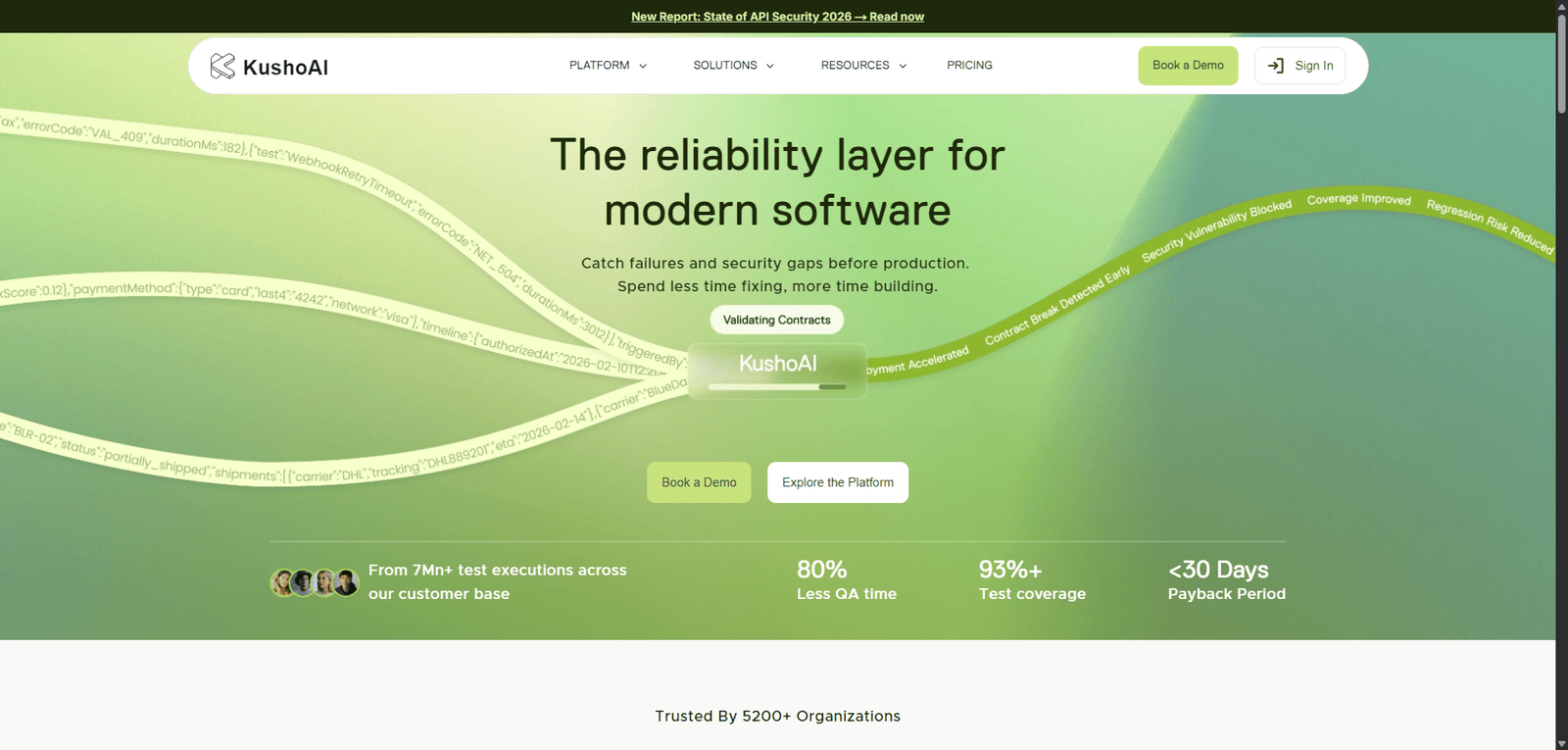
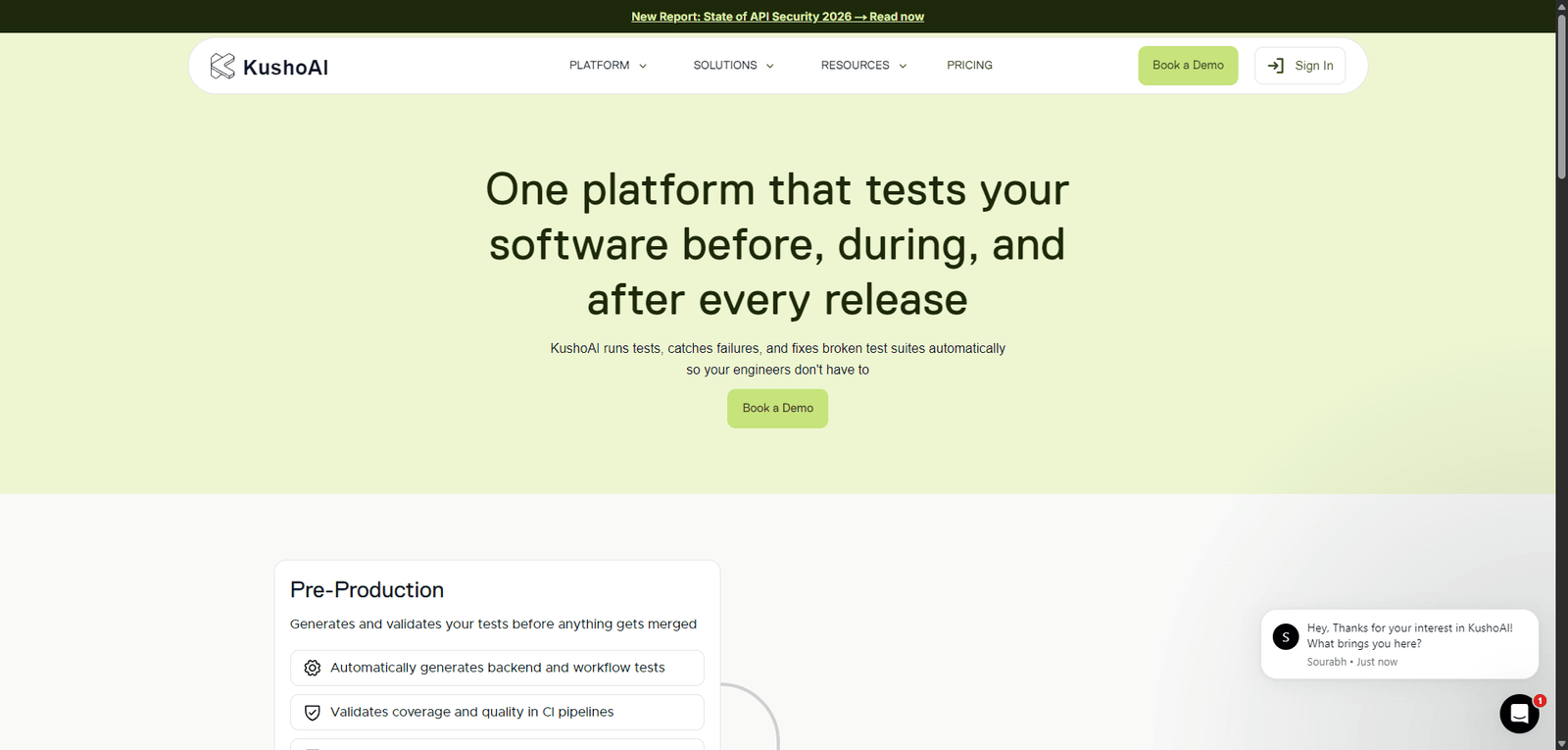




Kusho AI is an AI-powered API testing platform that helps teams automate backend testing, improve coverage, and accelerate development cycles. It is particularly valuable for API-first and microservices environments, while remaining less suitable for frontend or non-technical use cases.
Category: QA / API Testing Automation
Pricing Snapshot
| Plan | Price | Notes |
|---|---|---|
| Free Trial | Available | Limited API testing credits |
| Paid Plans | Not publicly disclosed | Usage-based or subscription |
| Enterprise | Custom | Advanced scaling, integrations, and support |
Pricing Transparency: Low — pricing is not fully public
Source Type
- Product positioning and API testing trends
- AI-driven QA automation platforms
- Comparison with API and backend testing tools
Overview
Kusho AI is an AI-powered QA testing platform focused on automating API and backend testing, enabling teams to generate, execute, and maintain tests with minimal manual effort.
Unlike traditional QA tools that rely heavily on scripting, Kusho AI emphasizes:
- Automatic test generation from API specifications
- Backend-focused testing workflows
- Reduced manual QA effort
- Faster and more reliable releases
Kusho AI positions itself as a developer-centric testing solution, particularly valuable for teams working with microservices, APIs, and modern backend architectures.
Key Features
1. AI-Powered API Test Generation
- Generate test cases directly from API schemas (e.g., OpenAPI)
- Reduce manual test writing
- Improve coverage across endpoints
2. Automated API Testing
- Execute tests across backend services
- Validate responses and performance
- Detect issues early in development
3. Smart Test Maintenance
- Automatically update tests as APIs evolve
- Reduce maintenance overhead
- Improve long-term QA efficiency
4. CI/CD Integration
- Integrate into DevOps pipelines
- Enable continuous testing
- Support faster deployments
5. Backend-Focused QA
- Designed for API-first architectures
- Supports microservices environments
- Enhances backend reliability
6. Reporting & Debugging Insights
- Provide detailed test reports
- Identify failures and root causes
- Improve debugging workflows
Use Cases
API Testing & Validation
- Test endpoints and responses
- Ensure API reliability
- Improve backend stability
Microservices Architecture
- Validate service interactions
- Test distributed systems
- Ensure system integrity
DevOps & CI/CD Pipelines
- Automate backend testing
- Reduce deployment risks
- Enable continuous delivery
SaaS Product Development
- Maintain API quality
- Detect bugs early
- Improve product performance
Pros and Cons
Pros
- Specialized AI-driven API testing automation
- Reduces manual test creation significantly
- Strong fit for backend and microservices environments
- Integrates with CI/CD workflows
- Improves test coverage and efficiency
Cons
- Pricing not transparent
- Limited public detail on supported frameworks
- Focused mainly on APIs (not full UI testing)
- Requires technical setup and API knowledge
- Not ideal for non-developers
Feature Comparison
| Feature | Kusho AI | Postman | SoapUI |
|---|---|---|---|
| AI Test Generation | Yes | Limited | No |
| API Testing | Yes | Yes | Yes |
| Automation | High | Medium | Medium |
| Ease of Use | Medium | High | Medium |
| CI/CD Integration | Yes | Yes | Yes |
Alternatives
| Tool | Best For | Key Difference |
|---|---|---|
| Postman | API testing | More manual but widely used |
| SoapUI | API QA | Traditional testing approach |
| Playwright | E2E testing | Focus on frontend + backend |
| Testim | AI QA | Broader UI + E2E testing |
Verdict
Kusho AI is a specialized AI QA platform that excels in API and backend testing automation, making it a strong choice for teams working with modern, API-driven architectures.
Its strengths include:
- Automated test generation from API specs
- Reduced maintenance overhead
- Strong CI/CD integration
However, limitations include:
- Limited pricing transparency
- Narrow focus on backend testing
- Requires technical expertise
Best suited for:
- Backend developers and API teams
- SaaS companies with microservices
- DevOps and QA engineers
Not ideal for:
- UI-focused testing needs
- Non-technical users
- Small projects without APIs
Rating
| Category | Score |
|---|---|
| Features | 4.6 / 5 |
| Ease of Use | 4.2 / 5 |
| Automation | 4.7 / 5 |
| Pricing Transparency | 2.8 / 5 |
| Overall | 4.5 / 5 |
FAQ
What is Kusho AI used for?
Kusho AI is used to automate API and backend testing using AI.
Does Kusho AI support UI testing?
No, it primarily focuses on API and backend testing.
Is Kusho AI suitable for CI/CD pipelines?
Yes, it integrates with modern DevOps workflows.
Does Kusho AI require coding?
It reduces coding but still requires technical understanding of APIs.
Who should use Kusho AI?
Backend developers, QA engineers, and DevOps teams.