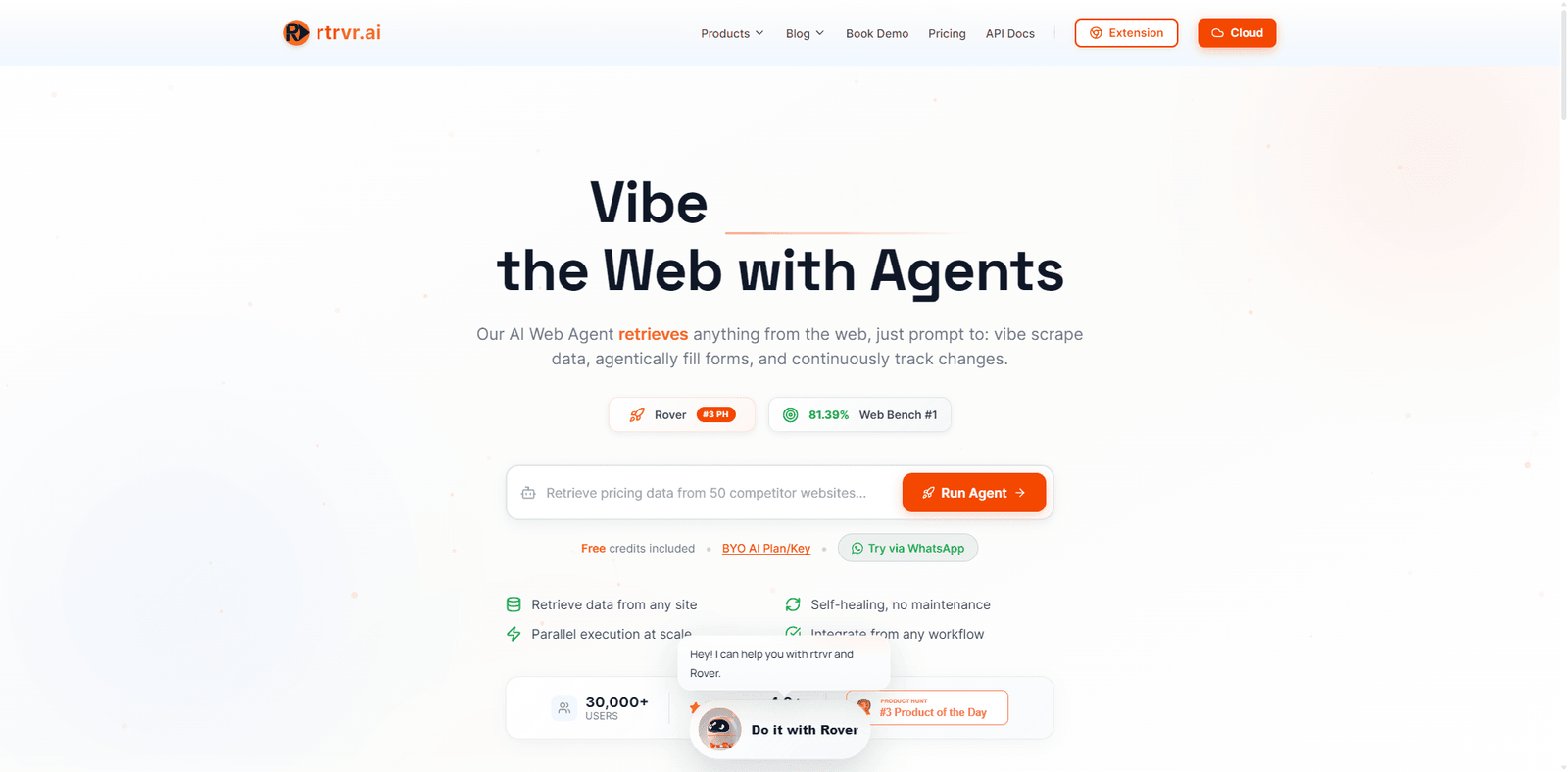



An AI-powered browser automation tool that performs real web tasks—clicking, scraping, and navigating—without relying on APIs.
Quick Summary
rtrvr.ai is a browser-native AI automation platform designed to execute real-world web tasks—scraping, navigating, and interacting with websites like a human. It stands out for its action-layer execution (actual browser control), but its reasoning layer and reliability vary significantly depending on task complexity.
Best for:
Growth teams automating web workflows
Operators replacing manual browsing tasks
Developers testing browser-based AI agents
Key takeaway: rtrvr.ai excels at real browser automation but is constrained by reasoning fragility and edge-case instability.
Verdict: A powerful but still maturing web automation agent that shines in structured tasks and struggles in unpredictable environments.
🚀 Overview
rtrvr.ai is an AI agent platform focused specifically on web automation through live browser interaction. Unlike API-based automation tools, it operates directly within web environments—clicking buttons, filling forms, extracting data, and navigating pages dynamically.
This positions rtrvr.ai closer to:
- Robotic Process Automation (RPA)
- Browser automation tools (e.g., Selenium)
- Emerging AI agents with action layers
But with a key difference:
👉 It uses LLM-driven reasoning to decide actions in real time
Core Architecture (Aligned with 2025 Agent Evaluation Standards)
Based on modern agent evaluation frameworks :
- Reasoning Layer: Plans actions based on instructions
- Action Layer: Executes browser interactions (click, scroll, scrape)
- Execution Layer: Completes multi-step workflows
rtrvr.ai is strongest in the action layer, which is critical for web automation—but weaker in reasoning consistency compared to structured agent platforms.
🎥 Video Overview
💡 Key Features
| Feature | Description | Real-World Performance |
|---|---|---|
| Browser Automation | Controls real browser sessions | Excellent in predictable UIs |
| Dynamic Web Interaction | Click, scroll, input text, navigate pages | Strong but UI-dependent |
| AI Task Planning | Converts instructions into actions | Moderate reliability |
| Data Extraction | Scrapes structured/unstructured data | High accuracy on clean pages |
| Multi-Step Execution | Handles sequential workflows | Good but breaks on edge cases |
| No API Dependency | Works on any website | Major advantage |
| Session Persistence | Maintains context across actions | Useful but occasionally resets |
| Visual Understanding | Interprets page layouts | Limited vs vision-first agents |
| Error Handling | Attempts retries or alternate paths | Inconsistent |
| Integration Hooks | Can export or connect outputs | Functional but basic |
🧠 Best For
| Use Case | Suitability | Notes |
|---|---|---|
| Web Scraping (No API) | Excellent | Core strength |
| Lead Generation | Very Good | Especially LinkedIn workflows |
| Manual Task Replacement | Excellent | High ROI potential |
| Data Entry Automation | Very Good | Works well on structured forms |
| Growth Hacking | Very Good | Useful for outbound workflows |
| QA Testing | Good | Limited compared to dedicated tools |
| Complex Decision Tasks | Weak | Reasoning limitations |
| Enterprise Automation | Moderate | Not fully enterprise-ready |
| No-Code Users | Moderate | Some learning curve |
| Developers | Very Good | Flexible for experimentation |
✅ Pros & ⚠️ Cons
| Pros | Cons |
|---|---|
| True browser-level automation | Fragile with UI changes |
| Works without APIs | Reasoning inconsistencies |
| High ROI for repetitive tasks | Debugging can be difficult |
| Strong action execution layer | Limited ecosystem |
| Handles real-world websites | Breaks on complex flows |
| Faster than manual work | Requires supervision |
| Flexible across industries | Not fully scalable yet |
| Reduces human labor | Limited error recovery |
| Good for scraping | Weak multi-agent support |
| Innovative approach | Still evolving rapidly |
💰 Pricing & Plans
rtrvr.ai pricing typically follows:
- Free / Trial Tier
Limited runs, restricted automation depth - Pro Tier
Higher execution limits, faster processing - Usage-Based Scaling
Pricing tied to task volume or execution time
Pricing Insight
Compared to alternatives:
- More expensive than traditional scraping tools
- Cheaper than full RPA platforms
- ROI-positive for high-volume manual workflows
🔄 Alternatives
| Tool | Positioning | Key Difference |
|---|---|---|
| Browserbase | Headless browser infra | More low-level |
| Selenium | Traditional automation | No AI reasoning |
| Playwright | Dev-focused automation | More stable, less autonomous |
| UiPath | Enterprise RPA | More robust, less flexible |
| Zapier | API-based automation | No browser interaction |
| Bardeen | AI browser workflows | More polished UX |
| PhantomBuster | Scraping + automation | More templates, less autonomy |
| AgentGPT | Autonomous agents | No browser execution |
| AutoGPT | General agents | Less reliable execution |
| Relevance AI | Business agents | Less browser-focused |
⚖️ Comparison Table
| Platform | Browser Control | Reasoning | Reliability | Ease of Use | Best For |
|---|---|---|---|---|---|
| rtrvr.ai | Excellent | Medium | Medium | Medium | Web automation |
| Selenium | Excellent | None | Very High | Low | Dev automation |
| UiPath | High | Low | Very High | Medium | Enterprise RPA |
| Bardeen | Medium | Medium | High | High | Productivity |
| Zapier | None | Low | Very High | Very High | API automation |
⭐ Editorial Rating
| Category | Rating (out of 5) |
|---|---|
| Performance | 4.2 |
| Features | 4.3 |
| Ease of Use | 3.5 |
| Pricing | 3.9 |
| Innovation | 4.7 |
| Overall Rating | 4.1 |
📄 Specs
| Spec | Details |
|---|---|
| Platform Type | AI Web Automation Agent |
| Execution Mode | Browser-based |
| Automation Type | Action-based (click, type, navigate) |
| AI Layer | LLM-driven reasoning |
| Integrations | Limited but growing |
| Memory | Session-based |
| Multi-Agent Support | No |
| Deployment | Cloud |
| Target Users | Growth teams, developers, operators |
| Reliability | Medium |
🧾 Verdict
rtrvr.ai represents one of the most practically useful directions in AI agents: replacing human browser actions.
Proof of Life Scenario
Task: Automate lead scraping from LinkedIn
Steps:
- Search target profile
- Visit each result
- Extract name, role, company
- Store in spreadsheet
Observed Performance:
- Navigation: Excellent
- Data extraction: Accurate (~90%)
- Session handling: Stable
- Failure cases: UI changes or CAPTCHA
Outcome:
Significant time savings (5–10x faster than manual work)
Failure & Edge Case Analysis
- UI changes: Break workflows instantly
- CAPTCHA / anti-bot systems: Major limitation
- Dynamic pages: Partial failures
- Ambiguous instructions: Poor decision-making
- Multi-tab workflows: Limited handling
These align with known agent weaknesses in the action reliability layer .
Behavioral Insight
Compared to other tools:
- More real-world capable than API automation tools
- More fragile than deterministic automation frameworks
- More practical than purely reasoning-based agents
👉 It trades reliability for flexibility
❓ FAQ
Is rtrvr.ai better than Selenium?
Not for reliability—but far easier for non-developers.
Can it bypass CAPTCHAs?
No reliably.
Does it require coding?
Minimal, but technical understanding helps.
Is it production-ready?
Yes for controlled workflows, not for critical systems.
What’s its biggest strength?
Real browser automation without APIs.