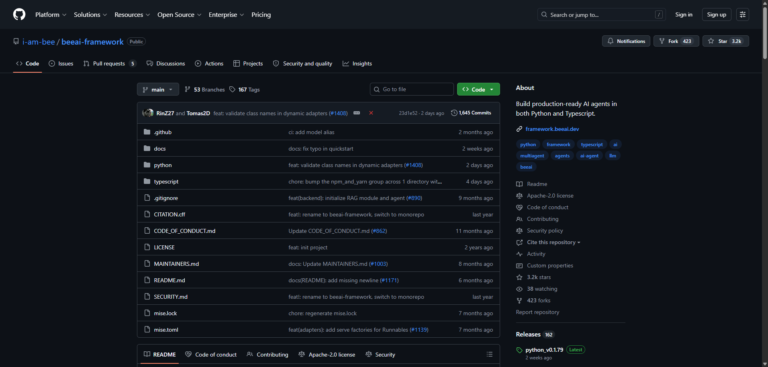



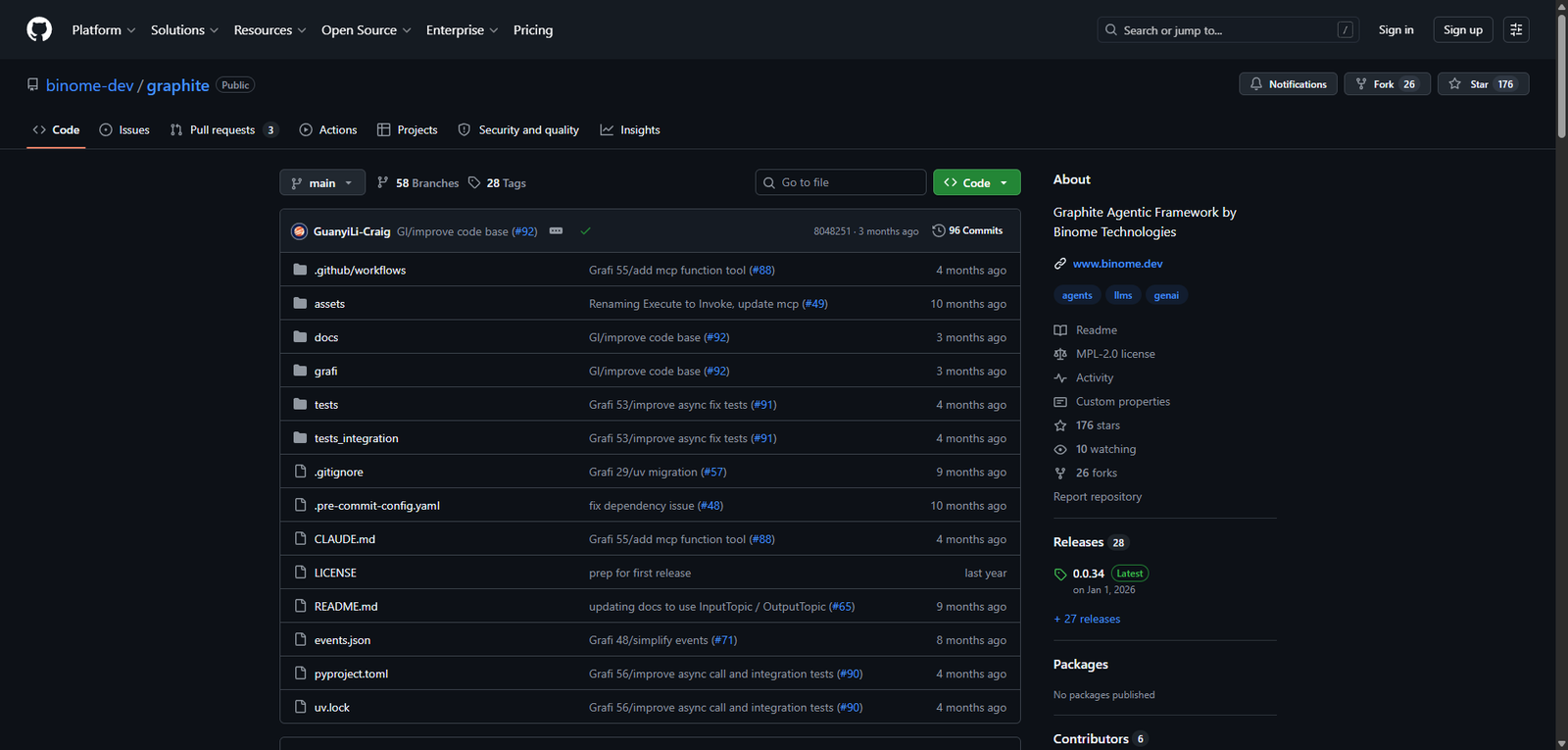
Graphite is an open-source framework for building AI agents and workflows using a modular, event-driven architecture. It enables developers to create scalable, observable, and fault-tolerant AI systems for production environments.
Graphite is a powerful open-source framework for building AI agents and workflows, offering a robust foundation for event-driven, scalable AI systems. It stands out for its modularity, observability, and reliability, making it an excellent choice for advanced users building complex AI applications.
Category: AI Agent Builder / AI Workflow Framework
| Plan | Price | Notes |
|---|---|---|
| Open Source | Free | Fully accessible and customizable |
| Managed/Enterprise | Not specified | hosted or enterprise support |
Pricing Transparency: High (core framework is open-source)
Graphite is an open-source framework for building AI agents and modular workflows, designed to support complex, event-driven AI systems. It enables developers to construct scalable AI applications using a component-based architecture that emphasizes observability, reliability, and flexibility.
Unlike no-code agent builders, Graphite is built for engineering teams that need:
At its core, Graphite acts as an AI orchestration framework, allowing users to design workflows where agents interact, process data, and respond dynamically to events.
| Feature | Graphite | LangChain | AutoGen |
|---|---|---|---|
| Open Source | Yes | Yes | Yes |
| Event-Driven Architecture | Yes | Limited | Yes |
| Modular Workflow Design | Yes | Yes | Yes |
| Observability | Strong | Moderate | Moderate |
| Ease of Use | Low | Medium | Medium |
| Tool | Best For | Key Difference |
|---|---|---|
| LangChain | LLM application development | Larger ecosystem and integrations |
| AutoGen | Multi-agent systems | More opinionated agent framework |
| CrewAI | Team-based agents | Focus on role-based collaboration |
| Temporal | Workflow orchestration | Not AI-native but highly reliable |
Graphite is a developer-focused AI workflow framework that excels in building modular, event-driven agent systems. Its architecture is well-suited for teams that require:
Its main trade-off is complexity—it is not designed for beginners or no-code users.
Best suited for:
Not ideal for:
| Category | Score |
|---|---|
| Features | 4.6 / 5 |
| Ease of Use | 3.4 / 5 |
| Flexibility | 4.8 / 5 |
| Documentation | 4.0 / 5 |
| Overall | 4.2 / 5 |
Graphite is used to build and orchestrate AI agents and workflows using a modular, event-driven architecture.
Yes, it is an open-source framework that can be customized and self-hosted.
Developers and engineering teams building scalable AI systems.
Yes, it is designed for reliability, fault tolerance, and scalability in production.
No, it requires technical expertise and is better suited for experienced developers.