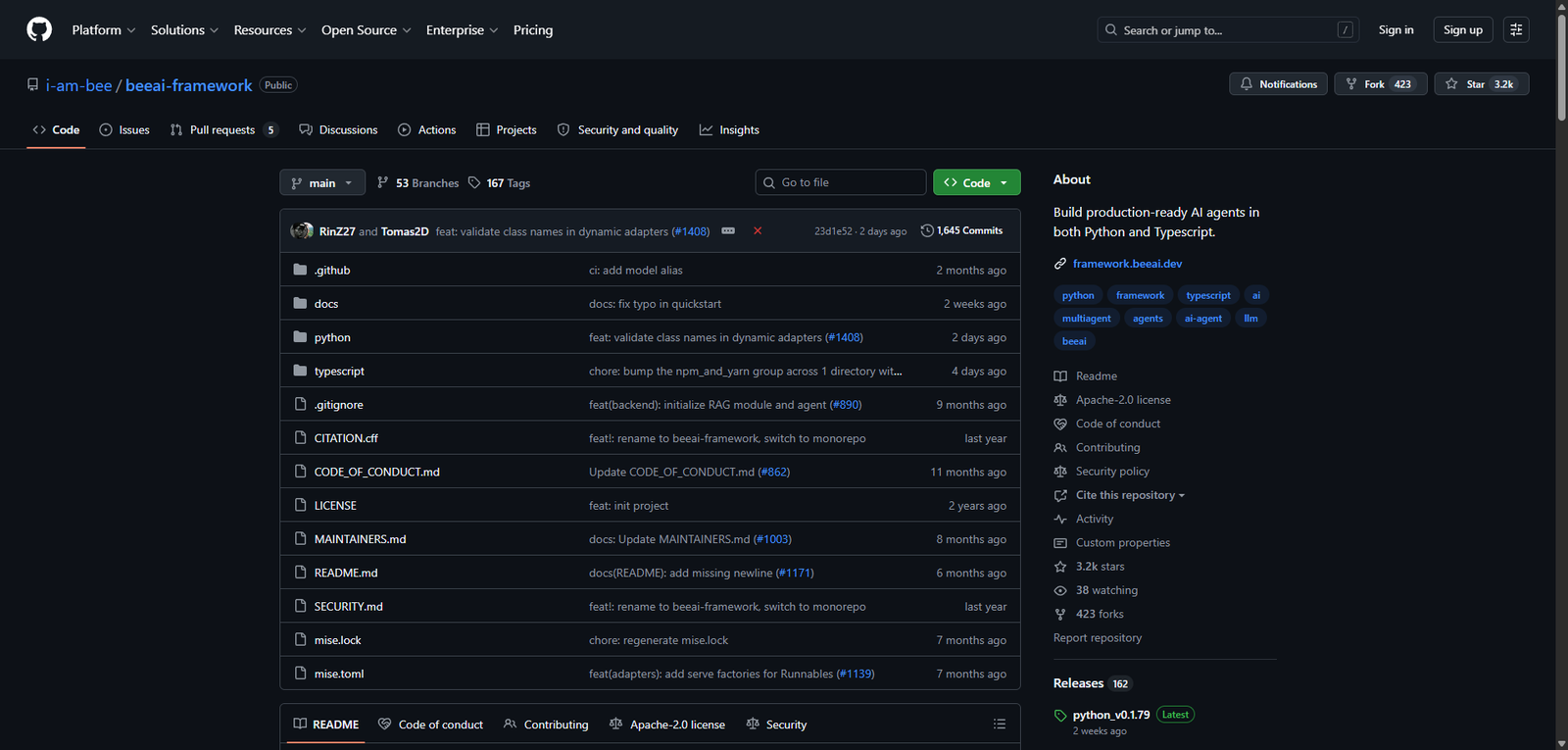


Bee AI is a developer-centric, open-source framework for building multi-agent AI systems, offering powerful tools for orchestration, state management, and scalability. It stands out for enabling collaborative agent architectures, making it a strong choice for advanced AI applications.
Category: AI Agent Builder / Multi-Agent Framework
Pricing Snapshot
| Plan | Price | Notes |
|---|---|---|
| Open Source | Free | Full access to core framework |
| Managed/Enterprise | Not specified | সম্ভাব্য enterprise support सेवाएँ |
Pricing Transparency: High — open-source availability
Source Type
- Open-source framework documentation and positioning
- Multi-agent system architecture analysis
- Comparison with AI orchestration frameworks
Overview
Bee AI is an open-source framework for building multi-agent AI systems, designed to support complex workflows where multiple agents collaborate, coordinate, and execute tasks. It provides developers with tools to orchestrate agents, manage state, and integrate with various LLM providers.
Unlike simpler agent builders, Bee AI focuses on multi-agent architectures, enabling:
- Coordination between multiple AI agents
- Workflow orchestration across tasks
- Scalable, production-ready AI systems
- Integration with diverse models and tools
It is particularly suited for developers building advanced AI systems that require collaboration between agents, such as autonomous workflows, decision systems, and complex automation pipelines.
Key Features
1. Multi-Agent System Support
- Design systems with multiple interacting agents
- Enable task delegation and collaboration
- Support complex decision-making workflows
2. Workflow Orchestration
- Coordinate agent interactions and task execution
- Manage dependencies between agents
- Build structured, multi-step workflows
3. Model-Agnostic Integration
- Works with multiple LLM providers (e.g., OpenAI, Groq, Ollama)
- Flexible model switching and configuration
- Avoid vendor lock-in
4. Memory & State Management
- Configurable memory strategies
- Persistent agent state handling
- Supports long-running workflows
5. Model Context Protocol (MCP) Support
- Standardized communication between models and tools
- Improves interoperability
- Enables extensible architectures
6. Token Usage Optimization
- Efficient context handling
- Reduces unnecessary token consumption
- Helps control operational costs
7. Structured Output Generation
- Produces consistent and machine-readable outputs
- Useful for downstream automation
- Improves reliability of workflows
8. Sandboxed Code Execution
- Execute code safely within controlled environments
- Supports advanced agent capabilities
- Enhances experimentation and flexibility
Use Cases
Multi-Agent AI Systems
- Build systems where agents collaborate on tasks
- Enable role-based agent architectures
- Handle complex workflows with interdependencies
Autonomous Workflows
- Automate multi-step processes with multiple agents
- Enable decision-making pipelines
- Reduce human intervention
AI Research & Experimentation
- Test multi-agent coordination strategies
- Experiment with different models and workflows
- Prototype advanced AI systems
Enterprise AI Applications
- Build scalable AI systems for operations
- Integrate agents into business workflows
- Manage complex automation at scale
Pros and Cons
Pros
- Fully open-source and developer-friendly
- Strong focus on multi-agent orchestration
- Supports multiple models and avoids vendor lock-in
- Advanced features like state persistence and sandboxing
- Scalable for production-grade systems
Cons
- Requires significant technical expertise
- Not suitable for no-code users
- Smaller ecosystem compared to established frameworks
- Documentation depth may vary
- Setup complexity for large systems
Feature Comparison
| Feature | Bee AI | LangChain | AutoGen |
|---|---|---|---|
| Multi-Agent Support | Strong | Moderate | Strong |
| Open Source | Yes | Yes | Yes |
| Workflow Orchestration | Yes | Yes | Yes |
| Model Flexibility | High | High | Medium |
| Ease of Use | Low | Medium | Medium |
Alternatives
| Tool | Best For | Key Difference |
|---|---|---|
| AutoGen | Multi-agent conversations | More opinionated architecture |
| LangChain | LLM applications | Larger ecosystem |
| CrewAI | Role-based agents | Simpler abstraction |
| Graphite | Workflow orchestration | Strong event-driven design |
Verdict
Bee AI is a powerful open-source framework for building multi-agent systems, offering the flexibility and control needed for advanced AI orchestration and collaboration.
Its strengths include:
- Deep support for multi-agent architectures
- Model-agnostic design
- Advanced workflow and state management
However, it is best suited for:
- Developers and AI engineers
- Teams building complex, production-grade systems
- Research and experimentation environments
Less suitable for:
- Beginners or non-technical users
- Simple automation tasks
- No-code AI solutions
Rating
| Category | Score |
|---|---|
| Features | 4.7 / 5 |
| Ease of Use | 3.5 / 5 |
| Flexibility | 4.8 / 5 |
| Documentation | 4.0 / 5 |
| Overall | 4.3 / 5 |
FAQ
What is Bee AI used for?
Bee AI is used to build multi-agent AI systems where multiple agents collaborate to complete complex workflows.
Is Bee AI open-source?
Yes, Bee AI is an open-source framework.
Does Bee AI support multiple LLM providers?
Yes, it integrates with multiple providers like OpenAI, Groq, and Ollama.
Is Bee AI beginner-friendly?
No, it is designed for developers and requires technical expertise.
What makes Bee AI different?
Its strong focus on multi-agent orchestration and scalable workflow design.