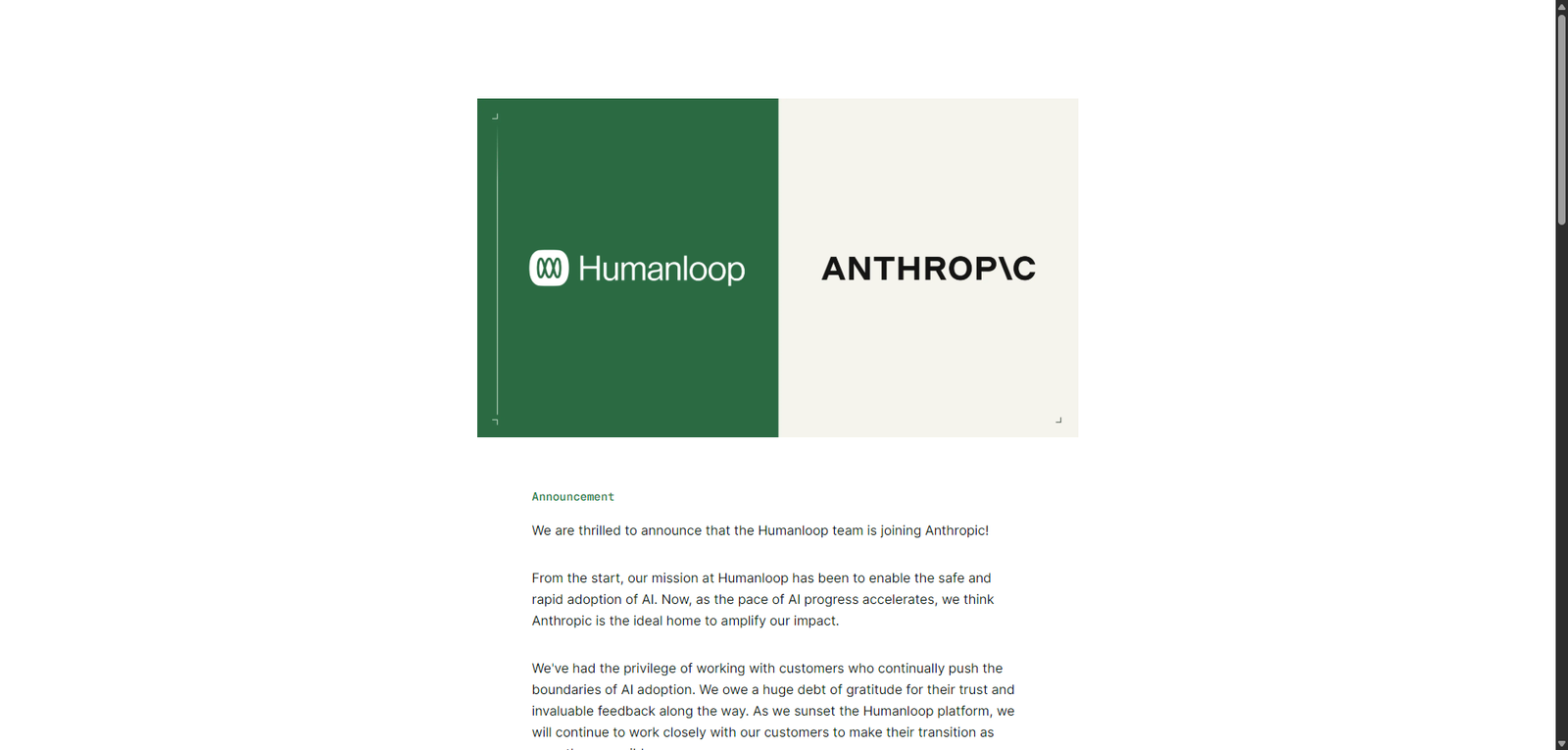

Humanloop is a powerful evaluation-first platform that helps teams bring structure, consistency, and collaboration to AI development. By focusing on workflow-driven evaluation and prompt management, it enables organizations to build more reliable and production-ready AI systems.
Category: AI Agent Builder / AI Evaluation Platform
Pricing Snapshot
| Plan | Price | Notes |
|---|---|---|
| Free Tier | Available | Basic access for individuals or small teams |
| Paid Plans | Not publicly disclosed | Likely usage-based or team pricing |
| Enterprise | Custom | Advanced deployment and support |
Pricing Transparency: Medium–Low — limited public pricing details
Source Type
- Product interface and feature descriptions
- AI evaluation and prompt engineering ecosystem analysis
- Developer tooling comparisons
Overview
Humanloop is a platform for developing AI evaluation workflows, designed to help teams build, test, and optimize AI systems through structured, iterative evaluation processes. It focuses on making evaluation a core part of the AI development lifecycle, rather than an afterthought.
The platform is particularly geared toward technical teams working with LLM-powered applications, offering tools to:
- Manage prompts with version control
- Automate evaluation workflows
- Monitor AI performance in real time
- Collaborate across engineering and product teams
Humanloop positions itself as a collaborative evaluation layer, bridging the gap between development, testing, and deployment of AI systems.
Key Features
1. Evaluation Workflow Builder
- Design structured evaluation pipelines
- Automate testing of prompts and outputs
- Standardize evaluation across projects
2. Prompt Version Control
- Track changes to prompts over time
- Compare different prompt versions
- Enable reproducibility and auditing
3. Real-Time Monitoring
- Monitor AI system performance in production
- Detect regressions and inconsistencies
- Track output quality over time
4. Collaborative Workspace
- Enable cross-functional team collaboration
- Share evaluation results and insights
- Align product, engineering, and AI teams
5. Automated Evaluations
- Run evaluations continuously
- Integrate into CI/CD pipelines
- Reduce manual testing effort
6. Flexible Deployment Options
- Integrate into existing development workflows
- Support multiple environments and use cases
- Adapt to different AI architectures
Use Cases
AI Product Development
- Build and refine LLM-powered applications
- Integrate evaluation into development cycles
- Improve product reliability before release
Prompt Engineering
- Test and optimize prompt variations
- Maintain version-controlled prompt libraries
- Improve output consistency and quality
Continuous AI Monitoring
- Track performance of deployed AI systems
- Identify issues in real time
- Ensure consistent user experience
Team Collaboration
- Align stakeholders around evaluation metrics
- Share insights across teams
- Improve iteration speed and quality
Pros and Cons
Pros
- Strong focus on evaluation as a core workflow
- Built-in prompt version control and tracking
- Supports collaborative AI development
- Enables continuous testing and monitoring
- Integrates well into modern development pipelines
Cons
- Pricing not clearly defined
- Requires technical expertise to implement fully
- Closed-source platform limits customization
- May overlap with other evaluation tools
- Setup complexity for smaller teams
Feature Comparison
| Feature | Humanloop | Braintrust | Phoenix |
|---|---|---|---|
| Evaluation Workflows | Yes | Yes | Yes |
| Prompt Version Control | Yes | Yes | Limited |
| Real-Time Monitoring | Yes | Yes | Yes |
| Open Source | No | No | Yes |
| Collaboration Tools | Strong | Strong | Moderate |
Alternatives
| Tool | Best For | Key Difference |
|---|---|---|
| Braintrust | Full lifecycle AI platform | More integrated dev + evaluation |
| Phoenix | Open-source observability | More flexible, developer-driven |
| LangSmith | LLM debugging | Strong LangChain ecosystem |
| Weights & Biases | ML monitoring | Broader ML focus |
Verdict
Humanloop is a specialized platform for building structured AI evaluation workflows, with a strong emphasis on prompt management, collaboration, and continuous testing.
Its key strengths include:
- Treating evaluation as a first-class component of AI development
- Enabling reproducible and version-controlled workflows
- Supporting collaboration across technical and non-technical teams
However, it comes with trade-offs:
- Limited pricing transparency
- Requires technical onboarding
- Closed ecosystem compared to open-source alternatives
Best suited for:
- Teams building production AI applications
- Organizations prioritizing evaluation and prompt quality
- Developers working on LLM-based systems
Not ideal for:
- Beginners or solo users
- No-code automation use cases
- Teams needing open-source solutions
Rating
| Category | Score |
|---|---|
| Features | 4.5 / 5 |
| Ease of Use | 3.9 / 5 |
| Collaboration | 4.6 / 5 |
| Pricing Transparency | 3.2 / 5 |
| Overall | 4.3 / 5 |
FAQ
What is Humanloop used for?
Humanloop is used to build, manage, and automate AI evaluation workflows, especially for LLM-based applications.
Does Humanloop support prompt versioning?
Yes, it includes version control for prompts, allowing teams to track and compare changes.
Is Humanloop open-source?
No, it is a closed-source platform.
Who should use Humanloop?
It is best suited for developers and teams working on production AI systems.
Can Humanloop be integrated into CI/CD pipelines?
Yes, it supports automated evaluations and integration into development workflows.