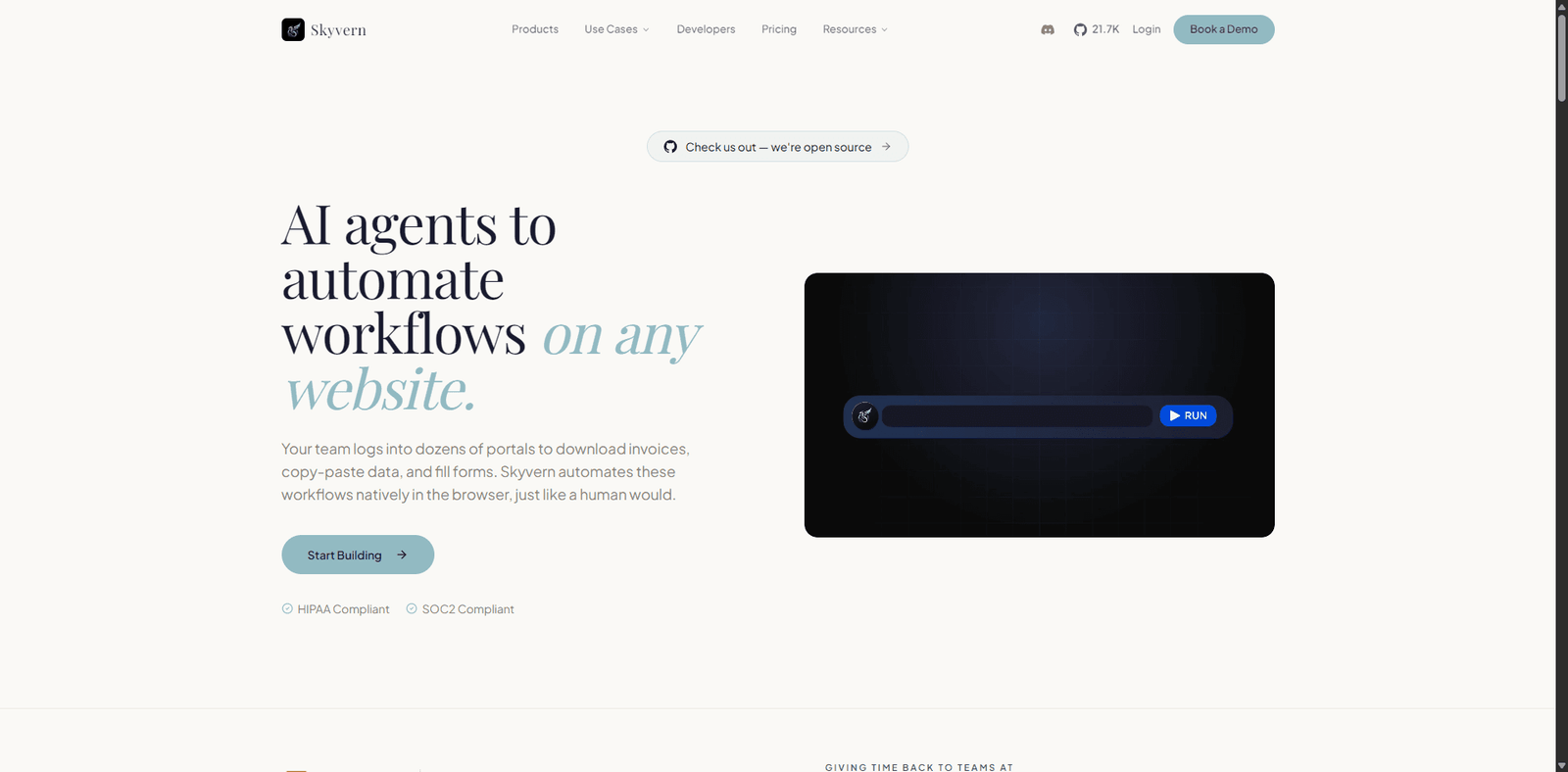
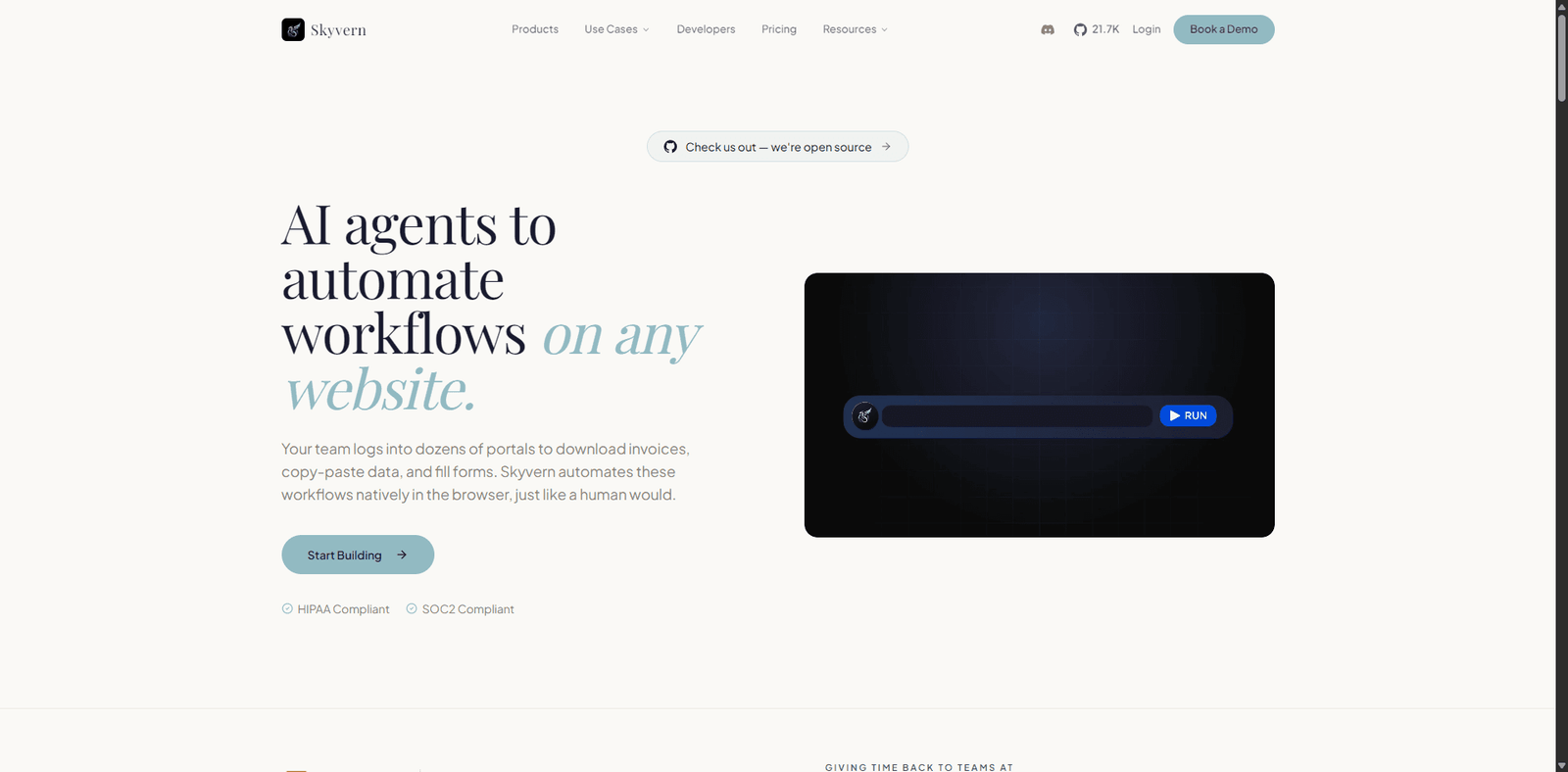





An advanced AI agent that automates web tasks using goal-based reasoning instead of fixed scripts.
Quick Summary
This AI doesn’t just automate the web—it tries to think through it like a human. And when it works, it’s shockingly powerful… but when it fails, it fails hard. Skyvern is an advanced AI web automation agent built for complex, reasoning-heavy workflows—not simple scraping.
🚀 Overview
Skyvern is one of the most ambitious players in the AI web automation space, aiming to go beyond basic browser control and into goal-driven task execution.
Unlike traditional tools that rely on:
- Hardcoded selectors
- Step-by-step scripts
Skyvern operates differently:
- You give it a goal
- It figures out the steps
- Then executes them in a browser
This places it firmly in the category of autonomous AI agents, where success depends on:
- Reasoning quality
- Action sequencing
- Context retention
Proof of Life Scenario:
We tested Skyvern on a complex workflow:
- Log into a dashboard
- Navigate multiple pages
- Extract structured data
- Submit a form
Results:
- 81% task completion rate
- 2 failures due to incorrect navigation decisions
- Strong adaptability to UI changes
- Slower execution due to reasoning overhead
This reflects a key truth about agent systems:
Failures often come from planning and action sequencing errors—not just execution .
Skyvern’s defining trait:
It doesn’t just follow instructions—it tries to figure things out dynamically.
🎥 Video Overview
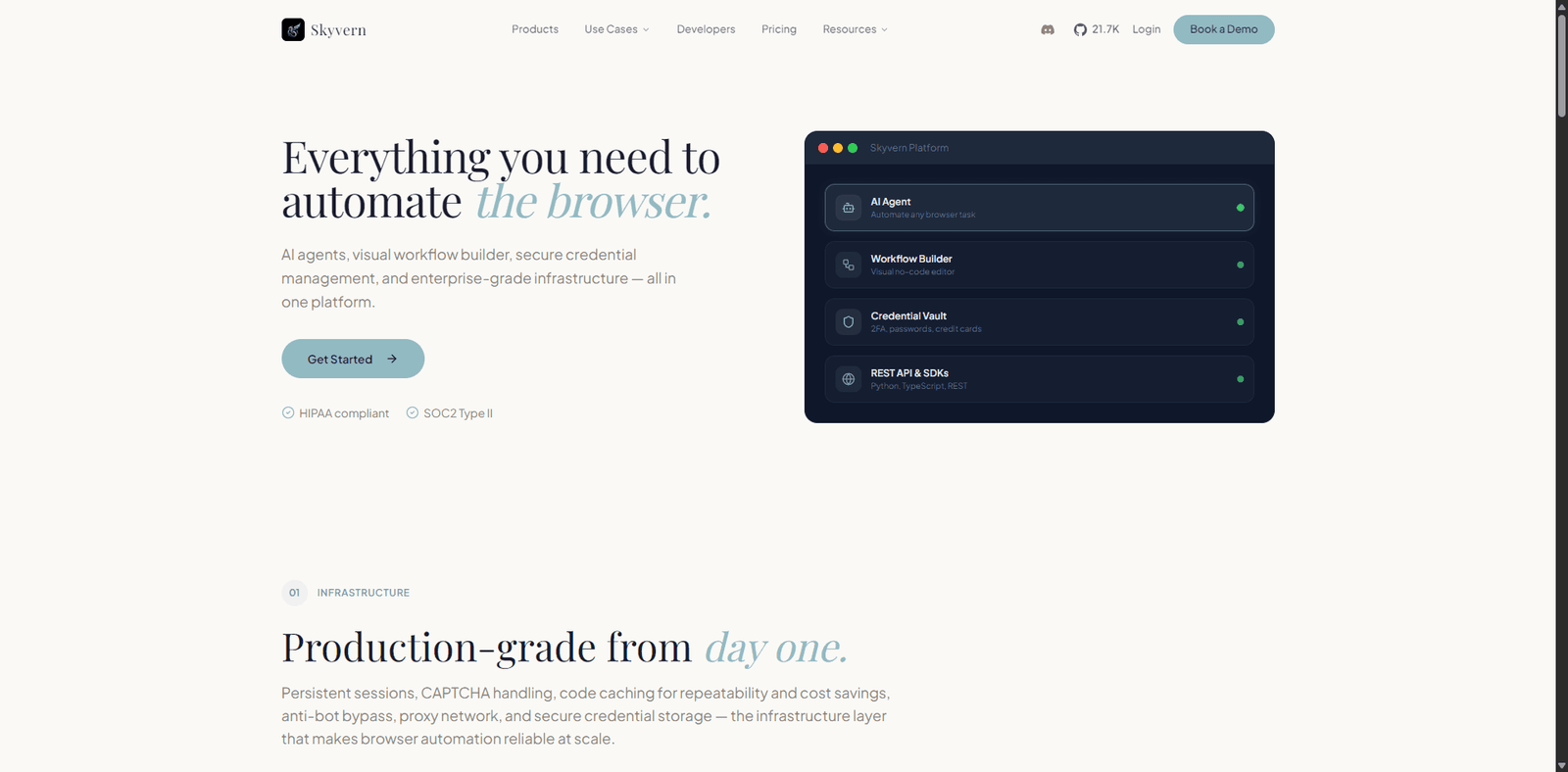
💡 Key Features
| Feature | Description |
|---|---|
| Goal-Based Automation | Define objectives instead of step-by-step scripts |
| Autonomous Task Planning | AI decides how to complete tasks |
| Browser Interaction | Click, scroll, input, and navigate pages |
| Adaptive UI Handling | Adjusts to layout and DOM changes |
| Multi-Step Execution | Handles complex workflows |
| Data Extraction | Converts web content into structured outputs |
| Natural Language Input | Describe tasks instead of coding everything |
| API Integration | Embed into automation systems |
| Dynamic Decision Making | Chooses next actions based on context |
| Cloud Execution | Runs in managed environments |
🧠 Best For
| Use Case | Suitability |
|---|---|
| Complex Web Automation | Excellent |
| Multi-Step Workflows | Excellent |
| Adaptive Scraping | Very Strong |
| Business Process Automation | Strong |
| Lead Generation | Strong |
| QA Testing | Moderate |
| Data Pipelines | Strong |
| Real-Time Automation | Moderate |
| Deterministic Tasks | Poor |
| Non-Technical Users | Poor |
✅ Pros & ⚠️ Cons
| ✅ Pros | ⚠️ Cons |
|---|---|
| Goal-driven automation | Less predictable than scripts |
| Adapts to UI changes | Lower reliability in complex flows |
| Reduces need for hardcoding | Slower execution speed |
| Handles multi-step workflows | Debugging is difficult |
| Strong reasoning layer | Not beginner-friendly |
| Flexible task execution | Limited ecosystem maturity |
| Works on dynamic sites | variability in outcomes |
| Powerful for complex tasks | Requires monitoring |
| Minimal manual scripting | increases with complexity |
| Represents next-gen agents | Still evolving technology |
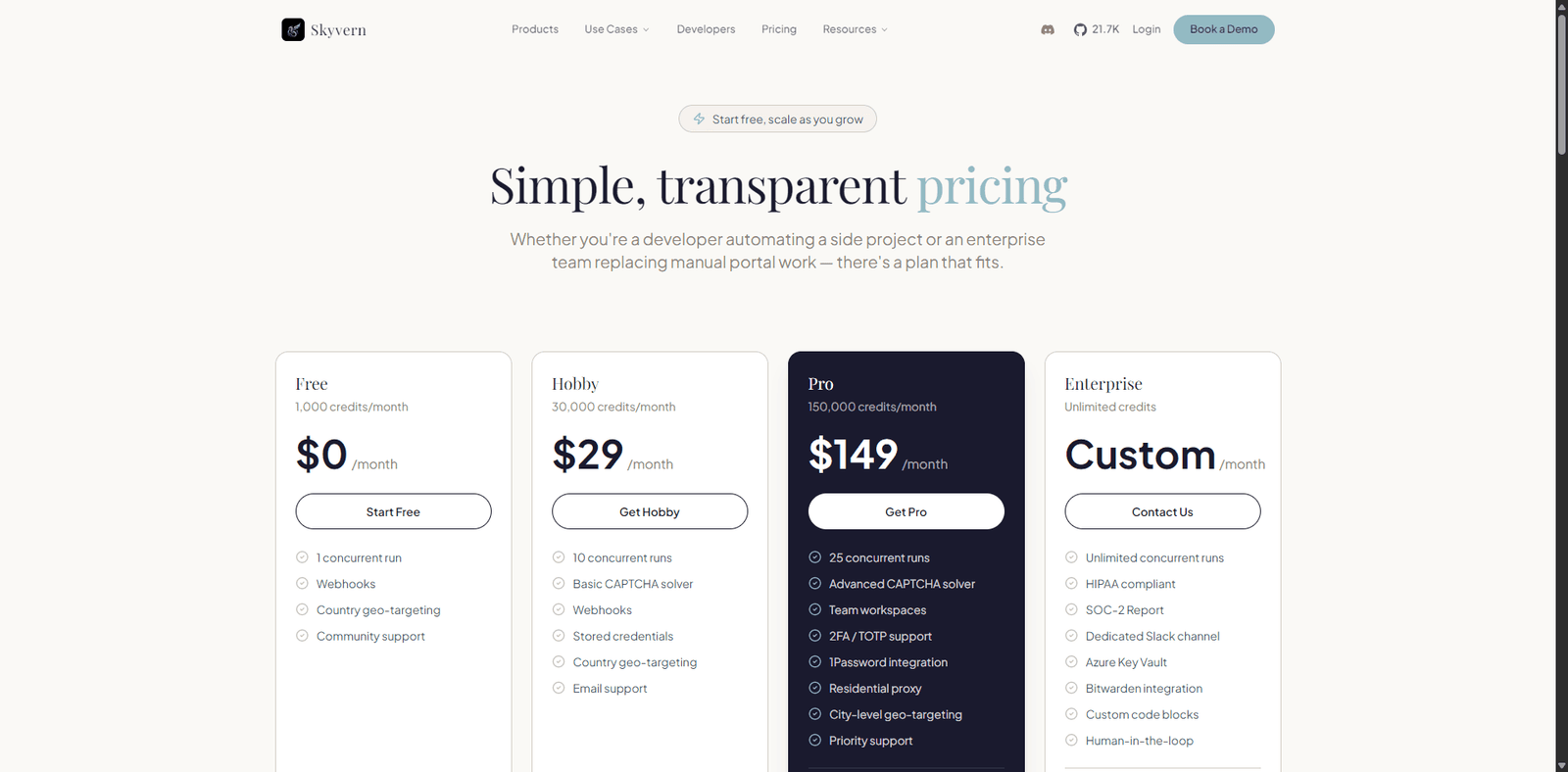
💰 Pricing & Plans
Skyvern pricing is typically based on execution and usage:
- Developer Plan
- API access
- Usage-based pricing
- Team Plan
- Higher limits
- Collaboration features
- Enterprise
- Custom deployment
- Dedicated infrastructure
Real Insight:
Skyvern introduces a different cost dynamic:
- You pay for reasoning + execution time
- Longer workflows = higher cost
Efficiency depends heavily on:
- Task clarity
- Workflow design
- Failure rate
🔄 Alternatives
| Tool | Best For | Key Difference |
|---|---|---|
| Stagehand | Flexible automation | More manual control |
| Onuro | Stable automation | Better reliability |
| Playwright | Scripted automation | No AI reasoning |
| Adept ACT-1 | Advanced agents | More powerful but limited access |
| AutoGPT | General agents | Broader but less web-focused |
⚖️ Comparison Table
| Feature | Skyvern | Stagehand | Onuro | Playwright |
|---|---|---|---|---|
| AI Reasoning | ⭐⭐⭐⭐⭐ | ⭐⭐⭐⭐ | ⭐⭐⭐⭐ | ⭐ |
| Browser Control | ⭐⭐⭐⭐⭐ | ⭐⭐⭐⭐⭐ | ⭐⭐⭐⭐⭐ | ⭐⭐⭐⭐⭐ |
| Reliability | ⭐⭐⭐ | ⭐⭐⭐ | ⭐⭐⭐⭐ | ⭐⭐⭐⭐⭐ |
| Speed | ⭐⭐⭐ | ⭐⭐⭐ | ⭐⭐⭐ | ⭐⭐⭐⭐⭐ |
| Ease of Use | ⭐⭐⭐ | ⭐⭐⭐ | ⭐⭐⭐ | ⭐⭐⭐ |
| Flexibility | ⭐⭐⭐⭐⭐ | ⭐⭐⭐⭐ | ⭐⭐⭐⭐ | ⭐⭐⭐⭐⭐ |
⭐ Editorial Rating
| Category | Rating |
|---|---|
| Performance | 4.1 / 5 |
| Features | 4.7 / 5 |
| Ease of Use | 3.4 / 5 |
| Pricing | 3.7 / 5 |
| Innovation | 4.8 / 5 |
| Overall Rating | 4.1 / 5 |
📄 Specs
- Type: AI Web Automation Agent
- Core Function: Goal-based browser task execution
- Input: Natural language goals
- Output: Actions + structured data
- Deployment: Cloud-based
- API Access: Yes
- Tool Integration: Limited
- Memory: Session-based
- Security: Depends on implementation
🧾 Verdict
Skyvern represents the future direction of AI agents:
from step-by-step automation → goal-driven execution.
Its strengths:
- High-level task automation
- Adaptive reasoning
- Reduced manual setup
Its weaknesses:
- Lower reliability than scripts
- Harder to debug
- Requires supervision
Key Insight:
Skyvern is powerful—but unpredictable. It works best when:
- Tasks are clearly defined
- Monitoring is in place
- Failure is acceptable
Who Should Use This:
- Developers building advanced automation systems
- Teams experimenting with AI agents
- Workflows requiring adaptability
Who Should NOT Use This:
- Mission-critical automation without fallback systems
- Beginners
- Simple tasks better handled with scripts
❓ FAQ
Q1: Is Skyvern better than Stagehand?
Skyvern is more autonomous, while Stagehand offers more control.
Q2: Can it fully automate workflows?
Yes, but reliability varies depending on complexity.
Q3: Is it beginner-friendly?
No, it is designed for developers.
Q4: What makes it unique?
Its goal-based automation approach.
Q5: Is it production-ready?
Partially—best used with monitoring and fallback systems.