


Interlify is a no-code platform that connects APIs to large language models, enabling users to build AI-powered workflows and integrations quickly and without complex coding.
Interlify is a lightweight, no-code platform for connecting APIs to LLMs, offering an accessible way to build AI-powered workflows. It is best suited for users who want to quickly integrate AI into their systems without complex development, though it may not meet the needs of highly advanced or large-scale implementations.
Category: AI Agent Builder / API Integration Platform
| Plan | Price | Notes |
|---|---|---|
| Free Tier | Available | Basic features and limited usage |
| Paid Plan | From $19/month | Entry-level access for individuals and small teams |
| Enterprise | Custom | Advanced integrations and scaling |
Pricing Transparency: Medium — entry pricing available, advanced tiers unclear
Interlify is a no-code platform designed to connect APIs with large language models (LLMs), enabling users to build automated workflows and AI-powered integrations without complex coding.
The platform simplifies how developers and non-technical users alike can:
Interlify positions itself as a bridge between APIs and AI, making it easier to operationalize LLMs within existing business processes.
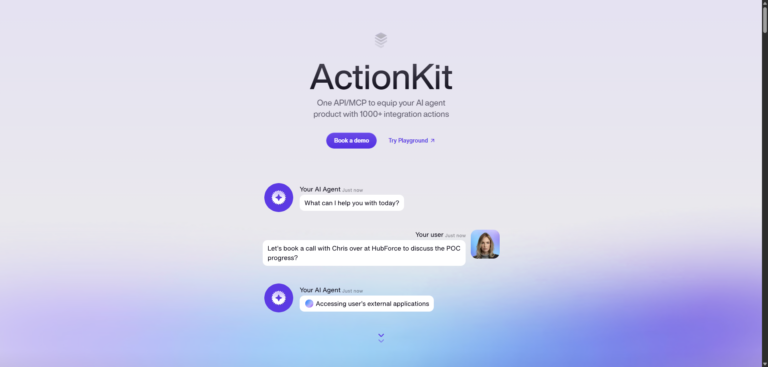
| Feature | Interlify | ActionKit | Zapier |
|---|---|---|---|
| No-Code Interface | Yes | No | Yes |
| API + LLM Integration | Yes | Yes | Limited |
| Ease of Use | High | Medium | High |
| Integration Depth | Medium | High | Medium |
| Pricing Accessibility | High | Low | Medium |
| Tool | Best For | Key Difference |
|---|---|---|
| Zapier | No-code automation | Less AI-native |
| Pipedream | API workflows | More developer-focused |
| Make (Integromat) | Visual automation | Rule-based logic |
| ActionKit | AI integrations | More developer-centric |
Interlify is a user-friendly, no-code platform for connecting APIs to LLMs, making it easier to build AI-powered workflows without heavy engineering effort. It stands out for its accessibility and affordability, particularly for users new to AI integrations.
Its strengths include:
However, limitations include:
Best suited for:
Not ideal for:
| Category | Score |
|---|---|
| Features | 4.2 / 5 |
| Ease of Use | 4.5 / 5 |
| Integration Capabilities | 4.0 / 5 |
| Pricing Value | 4.3 / 5 |
| Overall | 4.3 / 5 |
Interlify is used to connect APIs with large language models, enabling automated workflows and AI-powered integrations.
Yes, it provides a no-code interface for building integrations and workflows.
It offers a free tier, with paid plans starting at around $19/month.
It is ideal for small teams, startups, and non-technical users exploring AI automation.
It may work for smaller-scale enterprise use, but advanced needs may require more flexible platforms