


Stay Updated with the Latest AI Agent Insights

Join 24,000+ AI enthusiasts and professionals

Discover the newest AI agents, tools, and automation trends shaping the future of work. From powerful agent builders to cutting-edge workflow automation, we break down what matters so you can stay ahead.

Get expert insights, tool comparisons, and curated recommendations—all in one place.

Mem0 Review
Mem0 Review
  1. Mem0 Review
  2. Mem0 Review

Mem0 Review

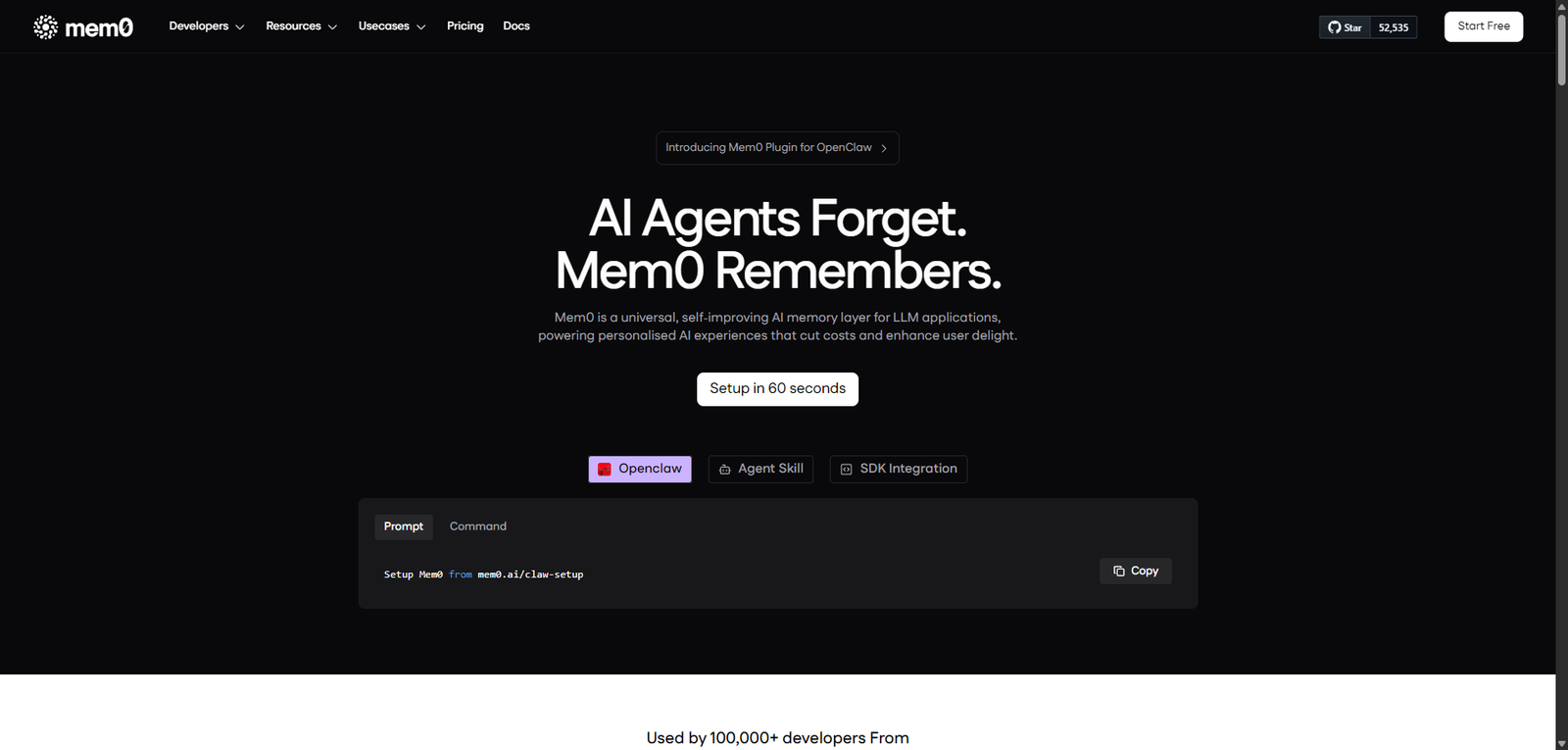
Mem0 is an AI memory layer that enables LLM applications to store and reuse context, delivering personalized and cost-efficient interactions. It helps developers build smarter, stateful AI systems with improved user experiences.

  • Overall
4.3/5Overall Score

Mem0 is a powerful AI memory layer that transforms stateless LLM interactions into context-aware, personalized experiences. It is particularly valuable for applications where continuity, efficiency, and user experience are critical, making it a key component in modern AI architectures.

Category: AI Agent Builder / AI Memory Infrastructure


Pricing Snapshot

PlanPriceNotes
Free TierAvailableBasic usage for testing
Paid PlanFrom $249/monthScales with usage and features
EnterpriseCustomAdvanced support and scaling

Pricing Transparency: Medium — entry pricing visible, scaling depends on usage


Source Type

  • Official product positioning and feature overview
  • AI infrastructure and LLM tooling analysis
  • Comparison with memory and context management solutions

Overview

Mem0 is an AI memory layer designed for LLM applications, enabling systems to store, retrieve, and utilize contextual information over time. Its primary goal is to make AI interactions more personalized, efficient, and cost-effective.

Unlike traditional stateless LLM interactions, Mem0 introduces persistent memory, allowing AI systems to:

  • Remember user preferences and past interactions
  • Deliver context-aware responses
  • Reduce redundant computations and token usage
  • Improve long-term user experience

Mem0 acts as an infrastructure layer, sitting between AI models and applications, enhancing how context is managed and reused.


Key Features

1. Persistent Memory Layer

  • Stores user interactions and contextual data
  • Enables long-term memory across sessions
  • Improves continuity in AI conversations

2. Personalized AI Experiences

  • Adapts responses based on user preferences
  • Learns from past interactions
  • Enhances engagement and relevance

3. Dynamic Graph Memory

  • Structures data in a graph-based format
  • Improves retrieval of related context
  • Supports complex relationship mapping

4. Cost Optimization

  • Reduces token usage by reusing stored context
  • Minimizes redundant queries to LLMs
  • Helps control operational costs

5. Seamless Model Integration

  • Works with major LLM providers (e.g., OpenAI, Claude)
  • Integrates into existing AI stacks
  • Flexible deployment options

6. Context-Rich Responses

  • Enhances output quality with historical data
  • Reduces repetitive user input
  • Improves conversational intelligence

Use Cases

Personalized AI Assistants

  • Remember user preferences and history
  • Provide tailored recommendations
  • Improve long-term engagement

Customer Support Automation

  • Maintain context across interactions
  • Reduce repeated questions
  • Improve resolution efficiency

E-commerce & Recommendations

  • Track user behavior and preferences
  • Deliver personalized product suggestions
  • Enhance user experience

AI Companions & Chatbots

  • Enable more natural, human-like conversations
  • Maintain continuity across sessions
  • Adapt to user needs over time

Pros and Cons

Pros

  • Adds persistent memory to LLM applications
  • Improves personalization and user experience
  • Reduces operational costs through context reuse
  • Supports modern AI stacks and integrations
  • Enables more natural, context-aware AI interactions

Cons

  • Pricing may be high for smaller projects
  • Requires integration into existing systems
  • Closed-source platform
  • Memory management complexity for large-scale use
  • Depends on proper data handling and governance

Feature Comparison

FeatureMem0LangChain MemoryPinecone
Persistent MemoryYesYesYes
Graph-Based MemoryYesLimitedNo
Cost OptimizationYesPartialNo
Ease of IntegrationMediumMediumMedium
FocusAI memory layerFramework featureVector database

Alternatives

ToolBest ForKey Difference
LangChain MemoryLLM workflowsBuilt into framework
PineconeVector storageNot memory-specific
WeaviateSemantic searchDatabase-focused
Redis + embeddingsCustom memoryRequires manual setup

Verdict

Mem0 is a specialized infrastructure tool for adding memory to AI applications, addressing one of the key limitations of LLMs: lack of persistent context. It enables developers to build more intelligent, personalized, and cost-efficient AI systems.

Its strengths include:

  • Strong focus on personalization and memory
  • Cost optimization through context reuse
  • Compatibility with modern AI stacks

However, considerations include:

  • Pricing for scaling applications
  • Integration complexity
  • Dependence on external infrastructure

Best suited for:

  • Developers building conversational AI systems
  • Products requiring long-term user context
  • Teams optimizing LLM costs and performance

Not ideal for:

  • Simple, stateless AI applications
  • Non-technical users
  • Projects without personalization needs

Rating

CategoryScore
Features4.6 / 5
Ease of Use3.9 / 5
Innovation4.7 / 5
Pricing Value3.8 / 5
Overall4.3 / 5

FAQ

What is Mem0 used for?

Mem0 is used to add persistent memory to AI applications, enabling personalized and context-aware interactions.

Does Mem0 reduce AI costs?

Yes, it reduces token usage by storing and reusing relevant context instead of reprocessing it.

Is Mem0 compatible with major LLMs?

Yes, it integrates with popular models like OpenAI and Claude.

Is Mem0 open-source?

No, it is a closed-source platform.

Who should use Mem0?

Developers and teams building AI applications that require memory, personalization, and efficiency.

Share your love
AI AGENT
AI AGENT
Articles: 131

Leave a Reply

Your email address will not be published. Required fields are marked *