


Discover the newest AI agents, tools, and automation trends shaping the future of work. From powerful agent builders to cutting-edge workflow automation, we break down what matters so you can stay ahead.
Get expert insights, tool comparisons, and curated recommendations—all in one place.
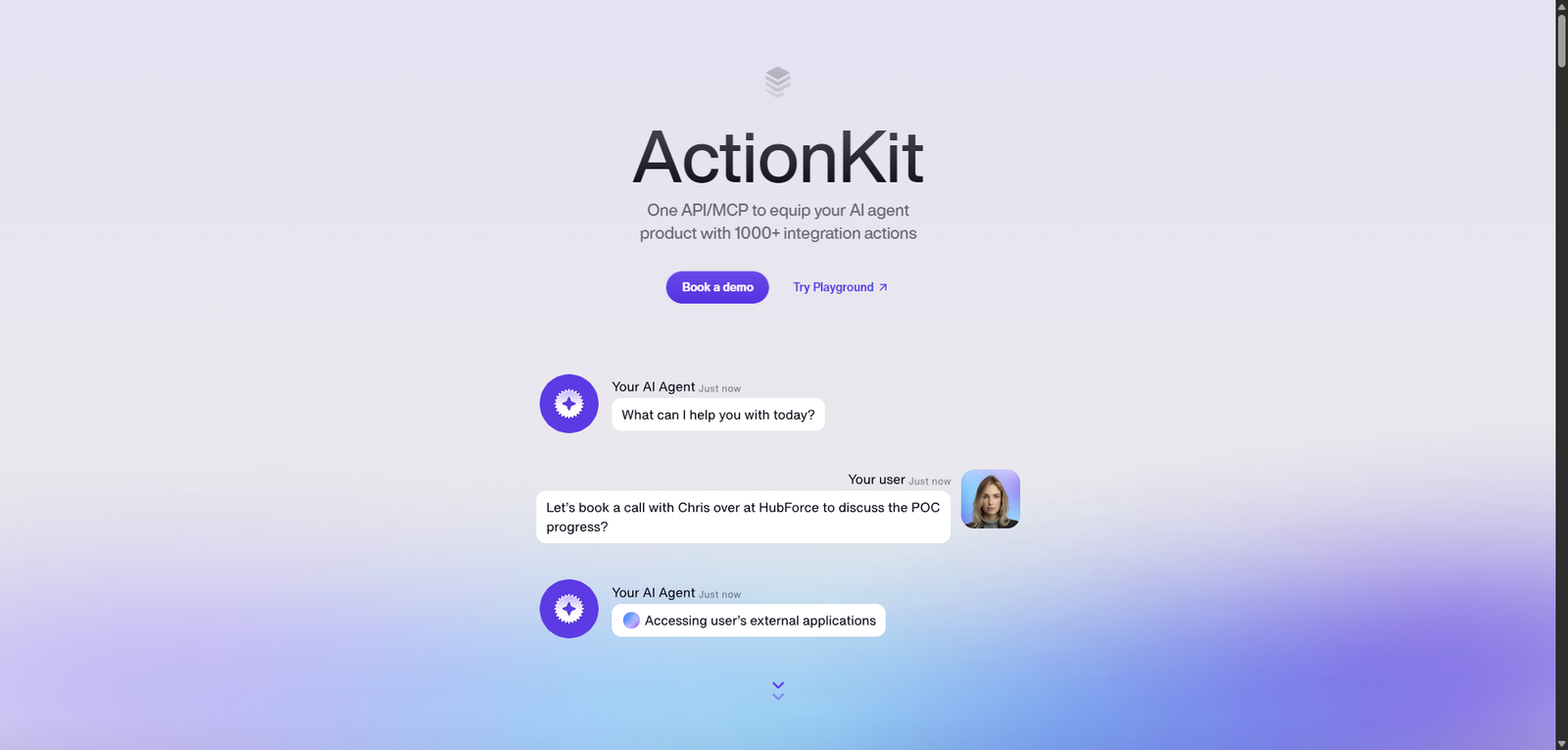
ActionKit is an API platform that connects AI agents to over 1,000 tools, enabling seamless automation and cross-platform workflows. It simplifies integrations with a unified interface and managed authentication for scalable AI applications.
ActionKit is a powerful integration layer for AI agents, enabling seamless interaction with over 1,000 tools through a unified API. It is best suited for developers building automation-heavy, multi-platform AI systems, offering scalability and efficiency at the cost of transparency and simplicity.
Category: AI Agent Builder / Integration Platform
Pricing Snapshot
Plan
Price
Notes
Free Tier
Not specified
Possibly limited or trial-based
Paid Plans
Undisclosed
Likely usage-based or API volume pricing
Enterprise
Custom
Scalable integrations and support
Pricing Transparency: Low — no public pricing details available
Source Type
Product overview and integration-focused positioning
API-based workflow automation analysis
Comparison with integration platforms and agent tooling
Overview
ActionKit is an API platform designed to connect AI agents with over 1,000 external tools and services, enabling seamless execution of tasks across different applications. It acts as an integration layer, allowing AI systems to interact with third-party platforms without requiring custom integrations for each service.
The platform is built to simplify how AI agents:
Query data from external systems
Execute actions across SaaS tools
Authenticate and manage connections
Automate workflows across multiple services
ActionKit essentially functions as a middleware layer for AI agents, reducing the complexity of building and maintaining integrations.
Key Features
1. 1000+ Tool Integrations
Connects AI agents to a wide range of SaaS platforms
Eliminates the need for custom API integrations
Supports common business and productivity tools
2. Unified API Interface
Single API to interact with multiple services
Simplifies development and reduces overhead
Standardizes how agents access external tools
3. Managed Authentication Flows
Handles OAuth and API authentication
Reduces complexity in securing integrations
Improves developer productivity
4. Action Execution Engine
Enables AI agents to perform actions (write, update, trigger workflows)
Supports real-time task execution
Useful for automation and orchestration
5. Event Logging & Debugging
Tracks API calls and execution logs
Helps identify issues and optimize workflows
Improves transparency in agent behavior
6. Pre-Built Integration Examples
Provides templates and examples
Speeds up onboarding and development
Demonstrates best practices
Use Cases
AI Agent Automation
Enable agents to interact with CRMs, databases, and SaaS tools
Automate multi-step workflows across platforms
Execute tasks without manual intervention
Workflow Orchestration
Coordinate actions across multiple systems
Trigger workflows based on events
Build cross-platform automation pipelines
Developer Productivity
Reduce time spent building integrations
Focus on core AI logic instead of API management
Accelerate product development
SaaS Integration Layer
Centralize integrations for applications
Maintain consistency across services
Scale integration capabilities efficiently
Pros and Cons
Pros
Supports 1000+ integrations, reducing development effort
Unified API simplifies complex workflows
Managed authentication improves security and ease of use
Enables real-time action execution for AI agents
Useful for building scalable automation systems
Cons
Pricing not publicly available
Closed-source platform limits customization
Reliance on third-party integrations
May introduce dependency on external infrastructure
Requires developer implementation
Feature Comparison
Feature
ActionKit
Zapier
Pipedream
AI Agent Integration
Yes
Limited
Yes
Number of Integrations
1000+
6000+
1000+
Unified API
Yes
No
Partial
Managed Authentication
Yes
Yes
Yes
Developer Flexibility
High
Medium
High
Alternatives
Tool
Best For
Key Difference
Zapier
No-code automation
Less developer-focused
Pipedream
API workflows
More flexible but less AI-centric
Make (Integromat)
Visual automation
Not AI-native
LangChain Tools
AI integrations
Requires manual setup
Verdict
ActionKit is a developer-focused integration platform that enables AI agents to interact with a wide ecosystem of tools through a single, unified API. Its main value lies in simplifying integration complexity and enabling cross-platform automation at scale.
Its strengths include:
Broad integration support
Streamlined authentication and API management
Strong fit for AI agent workflows
However, limitations include:
Lack of pricing transparency
Closed ecosystem
Dependency on external integrations
Best suited for:
Developers building AI-powered applications
Teams needing scalable integration infrastructure
Products requiring multi-tool automation
Not ideal for:
Non-technical users
Simple automation needs
Teams preferring open-source solutions
Rating
Category
Score
Features
4.5 / 5
Ease of Use
3.8 / 5
Integration Capabilities
4.7 / 5
Pricing Transparency
2.9 / 5
Overall
4.1 / 5
FAQ
What is ActionKit used for?
ActionKit is used to connect AI agents with external tools and services, enabling automated workflows and task execution.
How many integrations does ActionKit support?
It supports over 1,000 integrations with various SaaS platforms.
Is ActionKit no-code?
No, it is primarily a developer-focused API platform.
Does ActionKit handle authentication?
Yes, it provides managed authentication flows for integrations.