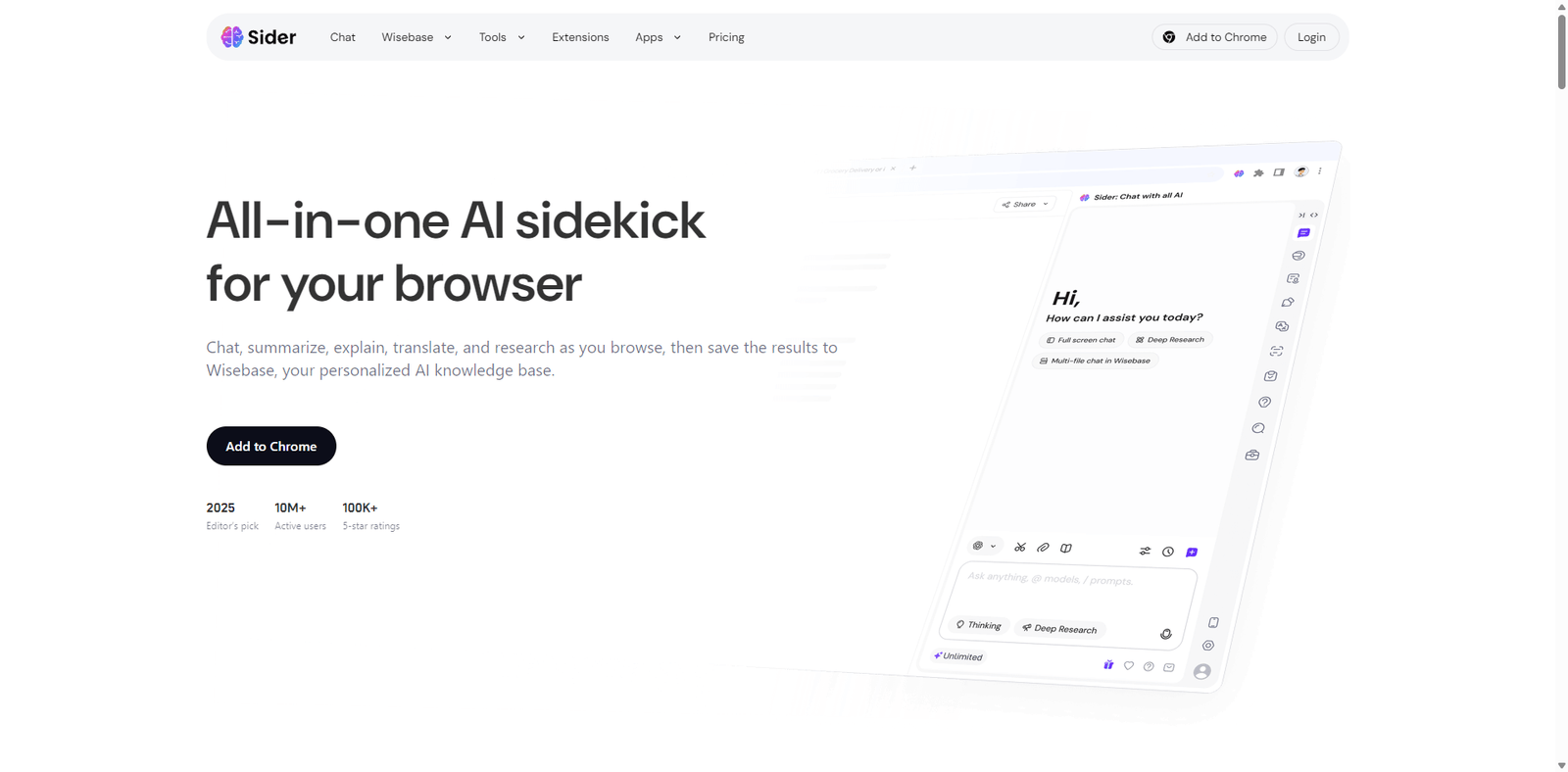

Sider Deep Research is an advanced AI research tool that helps users analyze, synthesize, and structure complex information across multiple sources. It is particularly valuable for deep research tasks, offering a balance of automation and analytical depth, while still requiring human validation for accuracy.
Sider Deep Research Review (2026): AI Research Assistant for Multi-Source Analysis & Knowledge Synthesis
Category: AI Research / Knowledge Assistant
Pricing Snapshot
| Plan | Price | Notes |
|---|---|---|
| Free Plan | Available | Limited queries and basic models |
| Pro Plan | From ~$10–$20/month | Access to advanced models and features |
| Advanced / Team | Custom | Higher limits and collaboration features |
Pricing Transparency: High — clear subscription tiers with feature scaling
Source Type
- Product positioning and AI research analysis
- AI assistants and deep research trends
- Comparison with research and knowledge tools
Overview
Sider Deep Research is an AI-powered research assistant designed to perform in-depth, multi-step analysis across multiple sources, helping users synthesize complex information into structured insights.
It builds on the broader Sider ecosystem, offering:
- Deep, multi-source research workflows
- Structured summaries and reports
- Cross-referencing of information
- Faster knowledge synthesis
Sider Deep Research positions itself as a “deep thinking AI”, going beyond simple answers to provide layered, contextual, and more comprehensive research outputs.
Key Features
1. Multi-Source Research Analysis
- Pull insights from multiple sources
- Compare and synthesize information
- Reduce fragmented research workflows
2. Deep Research Mode
- Perform multi-step reasoning
- Break down complex queries
- Generate structured outputs
3. Automated Summarization
- Summarize long articles and documents
- Extract key points and insights
- Improve research efficiency
4. Structured Reports
- Generate organized research outputs
- Use headings, sections, and logical flow
- Ready for presentations or documentation
5. Cross-Referencing Insights
- Identify connections between sources
- Improve depth of analysis
- Support better decision-making
6. Browser Integration
- Works as an extension or assistant
- Research directly while browsing
- Enhance productivity in real time
Use Cases
Academic Research
- Analyze complex topics
- Generate structured reports
- Speed up literature reviews
Business & Market Research
- Compare trends and competitors
- Generate insights for strategy
- Support decision-making
Content Creation
- Research topics deeply
- Generate outlines and summaries
- Improve content quality
Knowledge Work
- Understand complex subjects quickly
- Synthesize large datasets
- Improve productivity
Pros and Cons
Pros
- Strong multi-source research and synthesis capabilities
- Generates structured, in-depth outputs
- Saves time on complex research tasks
- Integrates with browsing workflows
- Beginner-friendly with advanced capabilities
Cons
- May still require fact-checking
- Output quality depends on available data
- Can be slower for deep analysis tasks
- Limited transparency on sources in some cases
- Advanced features may require paid plans
Feature Comparison
| Feature | Sider Deep Research | Perplexity AI | You.com |
|---|---|---|---|
| Multi-Source Analysis | High | High | Medium |
| Structured Reports | Yes | Limited | Yes |
| Real-Time Web Data | Yes | Yes | Yes |
| Depth of Reasoning | High | Medium | Medium |
| Ease of Use | High | High | Medium |
Alternatives
| Tool | Best For | Key Difference |
|---|---|---|
| Perplexity AI | Fast research | Strong citations and speed |
| You.com | AI search | Multi-model flexibility |
| ChatGPT | General research | More flexible but less structured |
| Elicit | Academic research | Focus on papers and citations |
Verdict
Sider Deep Research is a powerful AI research assistant that excels in multi-source analysis and structured knowledge synthesis, making it ideal for users who need deep, well-organized insights quickly.
Its strengths include:
- Deep research and reasoning capabilities
- Structured output formats
- Strong integration with browsing workflows
However, limitations include:
- Need for fact verification
- Occasional lack of source transparency
- Performance depends on query complexity
Best suited for:
- Researchers and students
- Content creators and analysts
- Professionals handling complex information
Not ideal for:
- Users needing guaranteed citation accuracy
- Simple or quick search queries
- Fully automated decision-making without validation
Rating
| Category | Score |
|---|---|
| Features | 4.6 / 5 |
| Ease of Use | 4.5 / 5 |
| Research Depth | 4.7 / 5 |
| Pricing Value | 4.3 / 5 |
| Overall | 4.5 / 5 |
FAQ
What is Sider Deep Research used for?
It is used for deep, multi-source research and generating structured insights.
Does it use real-time data?
Yes, it can incorporate web-based information.
Is Sider Deep Research beginner-friendly?
Yes, it is easy to use despite advanced capabilities.
Can it replace manual research?
It accelerates research but still requires validation.
Who should use it?
Researchers, analysts, students, and content creators.