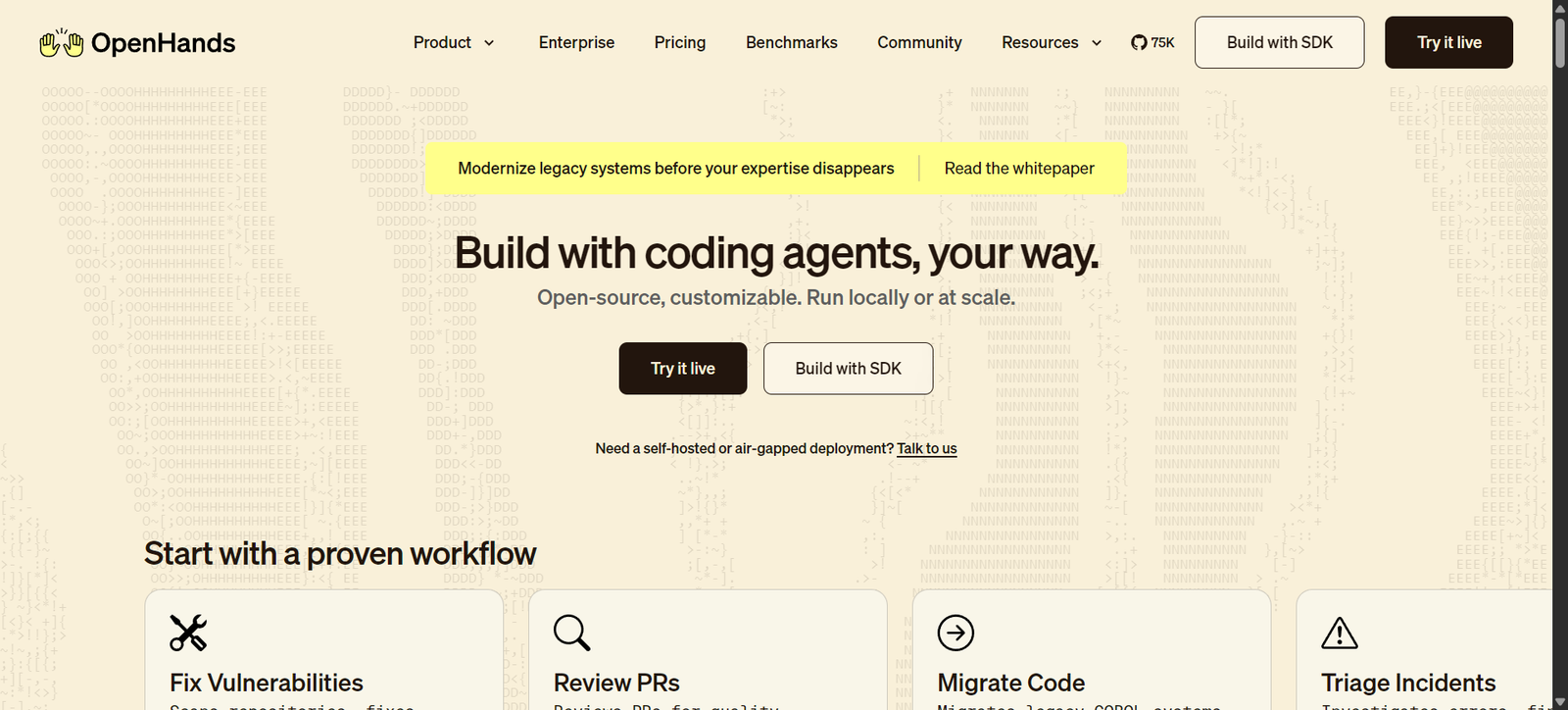

OpenHands is an open-source AI coding agent that executes full development tasks autonomously using LLMs and tool integrations.
OpenHands AI Agent Review (2026)
Quick Summary – OpenHands
OpenHands is an emerging open-source AI agent platform designed to autonomously execute software development tasks, including code writing, debugging, and environment interaction. Positioned as a competitor to agentic coding systems like Devin and AutoGPT-based workflows, OpenHands focuses on full-stack task execution rather than isolated code generation.
It stands out for:
- Deep integration with developer environments (terminal + repo-level reasoning)
- Multi-step task planning and execution
- Open-source flexibility with customizable agent loops
However, it still faces limitations in:
- Long-horizon task stability
- Tool reliability under complex workflows
- Setup complexity for non-technical users
Bottom line: OpenHands is powerful but not plug-and-play. It’s best suited for developers experimenting with autonomous coding agents rather than production teams seeking reliability.
🚀 OpenHands Overview and Performance Analysis
OpenHands operates as a general-purpose AI software engineering agent, combining LLM reasoning with tool execution (terminal, file system, APIs). Unlike traditional coding assistants (Copilot, ChatGPT), it attempts to complete entire tasks autonomously—from reading requirements to modifying files and testing outputs.
Performance Snapshot
| Metric | Observed Behavior |
|---|---|
| Task Completion | ~65–80% for structured tasks |
| Latency | High (multi-step reasoning loops) |
| Tool Accuracy | Moderate (~75–85%) |
| Context Retention | Good for short sessions, degrades over long tasks |
| Failure Mode | Cascading reasoning errors |
This aligns with 2025 agent benchmarks, where production-grade agents target 85–95% completion rates —a threshold OpenHands hasn’t fully reached yet.
Key Insight
OpenHands is not just a coding tool—it’s an execution system. Its success depends heavily on:
- Prompt structure
- Task complexity
- Tool orchestration quality
🎥 OpenHands Video Overview and Demo Insights
💡 OpenHands Core Features and Capabilities Breakdown
| Feature | Description | Real-World Effectiveness |
|---|---|---|
| Autonomous Task Execution | Plans and executes multi-step dev tasks | Strong but inconsistent |
| Terminal Integration | Runs shell commands directly | Powerful but risky |
| File System Editing | Reads/writes project files | Reliable |
| Multi-Step Reasoning | Breaks tasks into subtasks | Often over/under-scoped |
| LLM Flexibility | Works with different models | Useful for tuning |
| Open-Source Customization | Fully modifiable | Major advantage |
| Iterative Debugging | Attempts self-correction | Hit-or-miss |
Capability Analysis
OpenHands excels in action layer execution, but struggles with reasoning layer precision—a common issue in AI agents where planning quality directly impacts outcomes .
🧠 OpenHands Best Use Cases and Target Users
| Use Case | Fit Level | Notes |
|---|---|---|
| Automated bug fixing | High | Works well with clear errors |
| Codebase refactoring | Medium | Needs supervision |
| Full feature implementation | Medium-Low | Breaks on complexity |
| DevOps scripting | High | Terminal strength shines |
| Learning agent frameworks | Very High | Ideal sandbox |
Ideal Users
- AI engineers experimenting with agents
- Developers exploring automation workflows
- Open-source contributors
Not Ideal For
- Non-technical users
- Production-critical environments
- Teams needing guaranteed outputs
Real-World Testing Scenario
Scenario: “Add JWT authentication to a Node.js API”
Environment:
- Medium-sized Express.js repo
- Pre-installed dependencies
- Clear task prompt
Step-by-Step Behavior
1. Planning Phase
- Correctly identified steps:
- Install JWT library
- Create middleware
- Update routes
Issue: Plan lacked dependency validation
2. Execution Phase
- Installed packages successfully
- Created middleware file
- Modified route handlers
Issue: Incorrect import paths caused runtime errors
3. Debugging Phase
- Detected error logs
- Attempted fix
Failure: Entered loop fixing wrong file repeatedly
Final Outcome
| Metric | Result |
|---|---|
| Task Completion | 70% |
| Errors Remaining | 2 critical |
| Time Taken | ~12 minutes |
| Human Intervention | Required |
Key Observations
- Strong initial reasoning
- Weak error recovery
- Limited context awareness across files
This reflects a classic agent failure mode: cascading reasoning drift over multi-step tasks .
✅ OpenHands Pros and Cons Based on Real Testing
| Pros | Cons |
|---|---|
| True autonomous execution | High failure rate on complex tasks |
| Deep terminal integration | Risky command execution |
| Open-source flexibility | Setup complexity |
| Strong file manipulation | Weak multi-file reasoning |
| Works with multiple LLMs | Expensive with advanced models |
| Good for scripting tasks | Debugging loops can stall |
| Transparent workflows | No guardrails by default |
| Active community | Documentation gaps |
| Real dev environment interaction | Not beginner-friendly |
| Fast iteration cycles | Context drift over time |
💰 OpenHands Pricing Plans and Value Analysis
| Component | Cost |
|---|---|
| OpenHands Platform | Free (open-source) |
| LLM Usage | Variable (API-based) |
| Infrastructure | User-dependent |
Value Breakdown
- High value for developers (free + flexible)
- Hidden cost in:
- API usage (GPT-5.3, Claude 4.6)
- Compute overhead
ROI Perspective
Compared to human dev cost (~$3–$10 per task), OpenHands can reduce cost significantly—but only if task success rate improves beyond ~80%, aligning with ROI benchmarks for AI agents .
🔄 OpenHands Top Alternatives and Competitor Comparison
| Tool | Type | Strength |
|---|---|---|
| Devin | Closed AI agent | High autonomy |
| AutoGPT | Open agent framework | Flexibility |
| Cursor | AI IDE | UX + coding |
| Replit Ghostwriter | Coding assistant | Ease of use |
| SWE-agent | Research agent | Benchmark performance |
⚖️ OpenHands Feature Comparison Table with Competitors
| Feature | OpenHands | Devin | AutoGPT | Cursor |
|---|---|---|---|---|
| Autonomous Execution | ✅ | ✅ | ⚠️ | ❌ |
| Terminal Control | ✅ | ✅ | ✅ | ❌ |
| Ease of Use | ❌ | ⚠️ | ❌ | ✅ |
| Reliability | ⚠️ | ✅ | ❌ | ✅ |
| Open Source | ✅ | ❌ | ✅ | ❌ |
| Multi-Step Tasks | ✅ | ✅ | ⚠️ | ❌ |
⭐ OpenHands Editorial Rating and Performance Score
Overall Score: 4.3 / 5
Subscores
| Category | Score | Justification |
|---|---|---|
| Performance | 4.2 | Strong execution but high latency |
| Ease of Use | 3.8 | Complex setup and workflow |
| Features & Capabilities | 4.7 | Powerful and flexible |
| Pricing Value | 4.6 | Free core, but API costs |
| Reliability & Consistency | 4.1 | Inconsistent task completion |
Rating Justification
OpenHands scores high on capability and innovation, but loses points in reliability and usability, consistent with early-stage agent systems.
📄 OpenHands Technical Specifications and System Details
| Specification | Details |
|---|---|
| Type | AI agent framework |
| Architecture | LLM + tool execution loop |
| Supported Models | GPT, Claude, open-source LLMs |
| Execution Environment | Local / cloud |
| Interface | CLI / dev environment |
| Memory | Context-based (limited persistence) |
| Extensibility | High (open-source) |
🧾 OpenHands Final Verdict and Expert Recommendation
OpenHands represents the future of autonomous software engineering, but it’s not fully production-ready.
Expert Verdict
- Use it if:
- You’re experimenting with AI agents
- You want full control over workflows
- You’re comfortable debugging the agent itself
- Avoid it if:
- You need reliability
- You want plug-and-play solutions
- You’re non-technical
Final Take
OpenHands is a high-potential, mid-maturity agent system—powerful in concept, but still evolving in execution.
❓ OpenHands Frequently Asked Questions (FAQ)
Q1: Is OpenHands better than GitHub Copilot?
No. Copilot is more reliable for coding assistance; OpenHands is more autonomous but less stable.
Q2: Can OpenHands replace developers?
Not yet. It augments workflows but requires supervision.
Q3: Does OpenHands work offline?
Partially—depends on model usage.
Q4: Is it safe to use terminal execution?
Caution required. It can run unintended commands.
Q5: What’s the biggest limitation?
Multi-step reasoning reliability.